
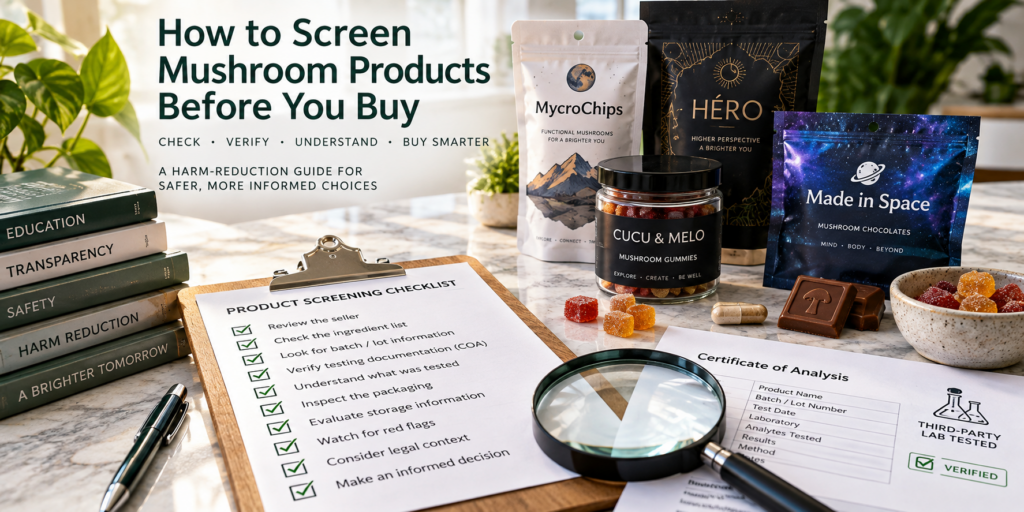
A harm-reduction guide to reading labels, evaluating testing information, spotting red flags, and making more informed decisions when shopping for mushroom products online.
The mushroom-product market has expanded rapidly online, giving consumers access to capsules, gummies, chocolates, jellies, candies, functional mushroom products, and products marketed with terms such as “mushroom blend” or “psychedelic.”
But attractive packaging does not answer the most important question:
What is actually in the product?
For consumers shopping online, screening a mushroom product means looking beyond flavor, branding, reviews, and marketing language. It means evaluating the ingredient list, identifying the mushroom species or active compounds being represented, checking batch information, examining available testing documentation, reviewing the seller itself, and understanding what important information may be missing.
That matters because mushroom products are not one uniform category. A lion’s mane supplement, an Amanita muscaria edible, and a product represented as containing psilocybin involve different compounds, effects, regulatory questions, and potential risks.
Federal investigations have also demonstrated why consumers should not assume that packaging tells the entire story. In its investigation of Diamond Shruumz-brand products, the FDA detected different compounds across samples, including muscimol, psilocin, acetylpsilocin, pregabalin, and kavalactones.
This guide explains how to conduct a practical product screen before buying or using a mushroom product—and why no single label, laboratory report, retailer, or marketing claim should be treated as a guarantee of safety or legality.
Quick Takeaways: How to Screen a Mushroom Product
- Start with the ingredients, not the front of the package. “Mushroom,” “functional,” “nootropic,” and “psychedelic” are not precise descriptions of what a product contains.
- Look for specific ingredient identification. A product should provide enough information for a consumer to understand what it represents itself as containing.
- Check for batch or lot information. Traceability becomes more difficult when there is no practical way to connect a package with its production batch.
- A COA should match the product being evaluated. Check the product name, batch or lot number, testing date, laboratory identity, and analytes tested when that information is provided.
- “Lab tested” does not automatically mean comprehensively tested. Different tests answer different questions.
- A potency result is not the same thing as a contaminant screen.
- A QR code is useful only when it leads to meaningful, relevant documentation.
- Do not assume two mushroom products contain the same compounds because their packaging or marketing sounds similar.
- Online availability does not establish legality. Federal, state, and local rules may differ.
- When important information cannot be verified, uncertainty itself should factor into the decision.
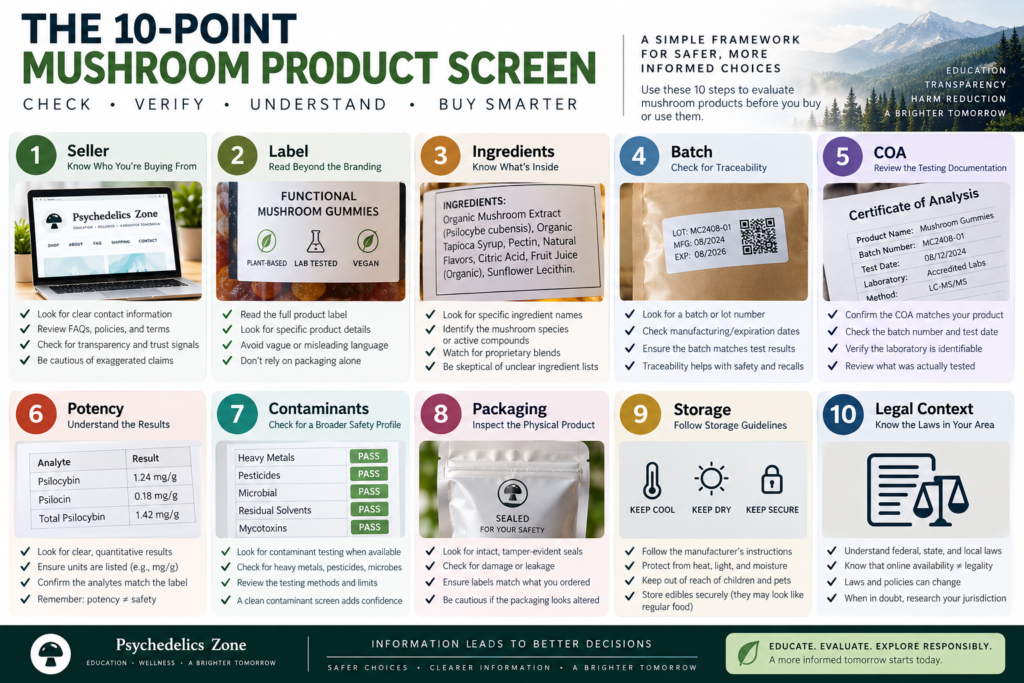
What Does “Screening” a Mushroom Product Actually Mean?
Screening is not the same thing as deciding whether you like a brand.
It is a process of gathering evidence.
A useful screen asks several independent questions:
Who is selling the product?
Can you identify the retailer and find meaningful policies, contact information, and product information?
What does the package claim is inside?
Are the ingredients specific, or does the label rely on vague terms?
Can the product be traced?
Is there a batch, lot, or other identifier?
What testing information is available?
If the seller makes a testing claim, can you examine documentation relevant to the product or batch?
What was actually tested?
Was the analysis for identity, potency, contaminants, or something else?
Does the documentation agree with the label?
Is the packaging intact and appropriate for storage?
Are the marketing claims realistic?
What laws apply where the consumer lives?
The point is not to find one magic indicator that makes a product “safe.” No such indicator exists.
Instead, consumers can look for multiple pieces of information that agree with one another.
Step 1: Screen the Seller Before the Product
Product screening can begin before a package reaches your home.
An online retailer should give consumers enough information to understand who they are dealing with and how the business operates.
Useful information can include customer-support channels, fulfillment information, shipping policies, FAQs, product descriptions, terms, privacy information, and geographic information.
For a national consumer, this is particularly important because availability can vary by location.
Psychedelics Zone operates as an online dispensary rather than a conventional walk-in storefront. Consumers exploring online access should separately evaluate product information, shipping availability, and the laws applicable to their location.
Shipping availability should never be interpreted as proof that a particular product is lawful in a particular jurisdiction.
Seller red flags
Be cautious when a seller provides little or no meaningful information about what it sells.
Potential warning signs include:
- Vague product descriptions
- Missing ingredient information
- Unsupported health or disease-treatment claims
- Testing claims with no accessible supporting information
- Documentation that cannot be connected to the product
- Packaging or website information that contradicts itself
- Pressure-oriented marketing designed to replace careful evaluation
- Claims that a product must be legal simply because it can be purchased online
No single issue necessarily tells you everything about a product, but multiple inconsistencies should increase scrutiny.
Step 2: Read the Ingredient List Before the Marketing Copy
“Mushroom product” describes a category, not an ingredient.
Different mushroom-related products can contain completely different substances.
A consumer may encounter products represented as containing functional mushroom species, mushroom extracts, Amanita ingredients, proprietary blends, psilocybin-containing mushrooms, or other compounds.
These categories should not be treated as interchangeable.
Watch for vague terminology
Terms such as:
- “proprietary mushroom blend”
- “magic blend”
- “mushroom complex”
- “psychedelic blend”
- “nootropic mushroom”
- “legal psychedelic”
may tell you very little by themselves.
Ask a more useful question:
What specific ingredient or compound does the label say produces the product’s intended effects?
If that cannot be determined from the label or supporting documentation, the consumer has less information with which to evaluate the product.
Step 3: Know the Difference Between Psilocybin and Amanita
This distinction deserves special attention.
Amanita muscaria and psilocybin-containing mushrooms are not two names for the same thing.
Psilocybin is converted in the body to psilocin and is associated with serotonergic psychedelic effects. Under current U.S. federal law, psilocybin and psilocin remain Schedule I controlled substances.
Amanita muscaria, by contrast, is associated with compounds including muscimol and ibotenic acid and has a different pharmacological profile.
The FDA stated in December 2024 that Amanita muscaria, its extracts, and the constituents muscimol, ibotenic acid, and muscarine are not authorized for use as ingredients in conventional food. FDA also concluded that these substances do not meet the GRAS safety standard for food use and advised consumers to avoid foods containing them.
FDA information about Amanita muscaria in food
This is one reason consumers should avoid treating the word “mushroom” as a meaningful description of active ingredients.
Step 4: Look for Batch and Lot Traceability
A polished package can tell you what a company wants a product to look like.
A batch or lot identifier helps answer a different question:
Which production run did this particular package come from?
Batch-specific identification can matter when reviewing testing documentation, investigating a complaint, or determining whether a product is included in a recall.
Useful identifiers may include:
- Lot number
- Batch number
- Manufacturing or packaging date
- Expiration or best-by information where applicable
- QR code tied to supporting product information
The exact traceability system varies by manufacturer and product category. What matters from a screening perspective is whether the physical product can meaningfully be connected with the documentation presented for it.
Step 5: Understand What a COA Can—and Cannot—Tell You
A Certificate of Analysis, commonly called a COA, is a laboratory document reporting results for the sample submitted for testing.
That definition is important.
A COA is evidence about a tested sample. It should not automatically be interpreted as a guarantee about every product a company has ever manufactured.
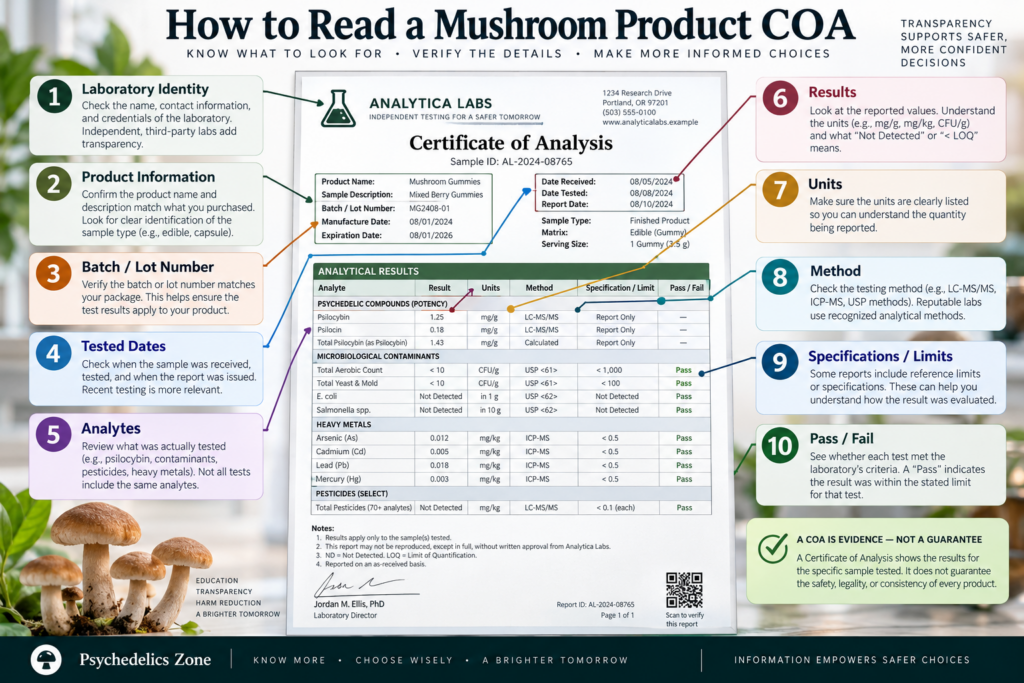
When reviewing a COA, compare:
- Product identity
Does the report identify the same product? - Batch or lot number
Does it correspond with the identifier on the package? - Testing date
Is it clear when the sample was analyzed? - Laboratory identity
Can you identify the laboratory shown on the report? - Analytes
What substances was the laboratory actually looking for? - Results and units
Are the findings clearly reported? - Scope
Was the test for potency, contaminants, identity, or multiple categories?
The most important habit is simple:
Read what was tested instead of stopping at the words “lab tested.”
Step 6: Potency Testing Is Not the Same as Contaminant Testing
Imagine a report showing a result for one active compound.
That result does not automatically tell you whether the same sample was evaluated for microbes, heavy metals, pesticides, residual solvents, or unexpected pharmacologically active substances.
Those are different analytical questions.
A consumer evaluating documentation can therefore ask:
Screening Area | What It May Help Answer | What It Does Not Automatically Establish |
Ingredient label | What the manufacturer says is present | Independent confirmation of contents |
Potency analysis | Amount of specified analyte detected in tested sample | Comprehensive contaminant screening |
Microbial testing | Whether specified microorganisms were detected within the test parameters | Potency or all chemical contaminants |
Heavy-metal panel | Levels of specified metals | Mushroom identity or potency |
Batch/lot number | Product traceability | Product safety by itself |
COA | Results for the submitted sample and listed analyses | Universal safety, legality, or consistency of every unit |
QR code | Convenient access to information | Accuracy of the information it links to |
Attractive packaging | Branding and product presentation | Identity, purity, potency, or legality |
This distinction helps prevent one of the biggest mistakes in product screening: asking a test result to prove something it was never designed to test.
Step 7: Why the Diamond Shruumz Investigation Matters
The FDA’s Diamond Shruumz investigation provides a useful real-world example of why product screening matters.
FDA reported testing 22 chocolate-bar samples, 10 infused-cone samples, 22 gummy samples, and one raw ingredient associated with the products. Its analyses identified different substances across different samples.
Among the reported findings were muscimol, acetylpsilocin, psilocin, pregabalin, and kavalactones. Not every compound appeared in every sample.
This article is not suggesting that those findings characterize mushroom products generally.
The narrower lesson is more useful:
Products that appear to belong to the same marketed category may not necessarily have identical chemical profiles.
That makes ingredient transparency, traceability, meaningful testing, and post-market safety information important components of consumer screening.
The investigation was associated with serious reported illnesses, and FDA ultimately completed the active investigation while continuing post-incident activities.
FDA’s Diamond Shruumz investigation
Step 8: Inspect the Physical Product When It Arrives
Screening should continue after delivery.
Before using an edible, capsule, chocolate, jelly, or candy, inspect the packaging.
Look for obvious signs that something may be wrong:
- Broken or compromised seals
- Unexpected leakage
- Damaged packaging
- Significant unexplained changes in appearance
- Missing labels
- Product information that does not match the order
- Missing batch identifiers that were expected
- Packaging that appears altered
If something seems inconsistent, damaged, or incorrectly labeled, obtaining clarification before consuming it is more sensible than guessing.
Step 9: Evaluate Storage Information
Product quality does not end at manufacturing.
Heat, moisture, light, time, and improper storage can affect many consumer products.
Follow the manufacturer’s applicable storage instructions rather than assuming all mushroom formats should be stored identically.
Adult-oriented products should also be stored securely away from children and pets, particularly edible formats that may resemble ordinary candy or chocolate.
This matters for gummies, chocolates, jellies, and candies because their appearance can make them difficult to distinguish from conventional food products.
Step 10: Screen the Claims as Carefully as the Ingredients
Sometimes the biggest red flag is not what a product says it contains.
It is what the seller says it will do.
Be cautious with claims that a mushroom product is guaranteed to:
- Treat depression or anxiety
- Cure a disease
- Replace prescription medication
- Produce a specific psychological outcome
- Be completely risk-free
- Work identically for everyone
Consumers should also be skeptical of claims that encourage them to discontinue prescribed medication.
Medication decisions should be made with an appropriate licensed healthcare professional.
Marketing confidence is not clinical evidence.
A Simple Three-Level Product Screening Framework
For readers who want an easier way to remember all of this, use three levels:
Level 1: Identity
Can I tell what this product represents itself as containing?
Review the label, ingredients, format, manufacturer information, and active ingredient claims.
Level 2: Verification
Is there evidence supporting those representations?
Review relevant laboratory documentation, batch information, dates, analytes, and whether the documentation actually corresponds to the product.
Level 3: Context
What else affects the decision?
Consider storage, medications, personal risk factors, product integrity, seller transparency, legal status, and the possibility that testing has limitations.
A product screen becomes stronger when all three levels tell a coherent story.
How Different Mushroom Product Formats Should Be Screened
Psychedelics Zone features formats including capsules, gummies, chocolates, jellies, and candies from approved brands such as MycroChips, HÉRO, CUCU & MELO, and Made in Space.
The format changes some of the practical questions consumers should ask. It does not make one format universally safer.
Capsules
With capsules, review ingredient identity, capsule contents, serving information, batch information, and applicable testing documentation.
Gummies, jellies, and candies
For edible formats, examine both the represented mushroom-related ingredients and the conventional food ingredients.
Secure storage is especially important because candy-like products can be mistaken for ordinary food.
Chocolates
Chocolate products introduce the same screening questions: ingredient transparency, product identity, batch information, storage, and documentation.
The FDA’s Diamond Shruumz investigation also demonstrates why consumers should not assume that an edible’s familiar format tells them what pharmacologically active substances it contains.
Harm Reduction: What to Do When Something Doesn’t Add Up
Product screening does not eliminate risk.
It helps identify uncertainty before a decision is made.
If the COA doesn’t match the package
Do not assume a report from a different product or batch applies to the item in front of you.
Seek clarification.
If there is no ingredient transparency
Recognize that you have less information about what you may be consuming.
If a QR code is broken
Try obtaining the documentation through the seller or manufacturer rather than assuming what the unavailable page would have shown.
If the package arrives damaged
Avoid using a product when its integrity is questionable until the issue has been resolved.
If you take prescription medication
Do not stop, skip, taper, or alter prescribed medication in order to use a mushroom or psychedelic product.
Discuss potential interactions with an appropriately qualified healthcare professional.
If you feel seriously unwell after consuming a product
Seek appropriate medical assistance. In an emergency, contact emergency services. In the United States, Poison Help can be reached at 1-800-222-1222.
When possible, retain the packaging and relevant product information so healthcare professionals can understand what was reportedly consumed.
Product Screening and Online Mushroom Dispensaries
Online shopping makes information quality particularly important because consumers cannot physically inspect a package before ordering.
A responsible screening process can therefore begin with the website itself.
Psychedelics Zone operates as an online dispensary, serving customers through shipping rather than a conventional walk-in storefront.
Learn how the Psychedelics Zone online mushroom dispensary works
National readers who want to explore geographic information can use the site’s location hub.
Explore mushroom dispensary locations
Consumers should still understand an important distinction:
Where a company ships and what the law permits are separate questions.
Psilocybin remains a Schedule I controlled substance under current federal law. State and local psychedelic policies vary, and local decriminalization should not automatically be interpreted as legalization or authorization of commercial sales.
Readers should check the laws applicable to their own jurisdiction.
The 60-Second Mushroom Product Screen
Before buying or consuming a mushroom product, ask:
- Who made and sold it?
Can I identify the company? - What does it say it contains?
Are ingredients specific? - What kind of mushroom product is this?
Functional mushroom, Amanita-related product, psilocybin-related product, or something else? - Is there a batch or lot number?
- Is testing documentation available when testing is claimed?
- Does the documentation match this product and batch?
- What exactly was tested?
- Is the package intact?
- Are the claims realistic?
- Have I separately checked legal and personal safety considerations?
If several answers are unclear, you have learned something important from the screen:
There is meaningful uncertainty about the product.
Frequently Asked Questions
How can I tell whether a mushroom product is legitimate?
No single feature establishes legitimacy. Review the seller, ingredient information, batch or lot identification, packaging, testing claims, available documentation, and consistency among those pieces of information. A polished website or package alone is not verification.
What should I look for on a mushroom product COA?
Look for the product or sample identity, batch or lot number where applicable, testing date, laboratory identity, analytes tested, reported results, units, and scope of analysis. Most importantly, determine whether the document actually corresponds to the product you are evaluating.
Does “lab tested” mean a mushroom product is safe?
No. “Lab tested” is incomplete without knowing what was tested, which sample was tested, which methods were used, and what the results showed. Testing can provide useful evidence, but it does not establish zero risk.
Is a QR code enough to verify a mushroom product?
Not by itself. A QR code is simply a way of accessing information. Evaluate the documentation it leads to, including whether the product and batch information match.
Are Amanita mushroom products the same as psilocybin products?
No. Amanita muscaria and psilocybin-containing mushrooms involve different active compounds and pharmacology. FDA has also stated that Amanita muscaria, its extracts, muscimol, ibotenic acid, and muscarine are not authorized as ingredients in conventional food.
Are mushroom gummies safer than mushroom chocolates?
The format alone does not establish safety. Gummies and chocolates should both be evaluated for ingredients, labeling, batch information, relevant testing documentation, packaging integrity, storage, and other risk factors.
Can I trust a product because it is sold online?
Online availability does not establish product quality, safety, regulatory compliance, or legality. Evaluate the product and seller separately, and check the laws that apply to your location.
Is psilocybin federally legal if my city has decriminalized it?
Local decriminalization and federal scheduling are different legal concepts. Psilocybin remains Schedule I under federal law. A local policy reducing enforcement priority does not by itself change federal law or necessarily create a legal commercial market.
What should I do if the product I receive doesn’t match its online description?
Do not simply assume the difference is harmless. Compare the packaging, ingredients, product name, and batch information with the order and available documentation, and contact the seller for clarification before deciding whether to use it.
Where can I see whether Psychedelics Zone serves my location?
Use the Psychedelics Zone location hub for geographic information. Availability should still be considered separately from the laws that apply in your jurisdiction.
Psychedelics Zone location hub
Bottom Line: Screen the Evidence, Not Just the Packaging
The best product screen is not based on a logo, flavor, review, QR code, or the phrase “lab tested.”
It looks at the whole picture.
Start with identity: what does the product claim to contain?
Move to verification: what relevant evidence supports those claims?
Finish with context: is the package intact, are the claims credible, are there personal safety considerations, and what laws apply where you live?
The FDA’s investigation of Diamond Shruumz products offers a useful reminder that products marketed within the same broad category can contain compounds consumers may not expect.
For national consumers, careful screening is particularly important when shopping online. Psychedelics Zone provides an online-dispensary hub and location directory to help readers navigate product and geographic information, but online availability should never be treated as proof of legality.
When important information is missing, uncertainty is itself useful information.
Legal, Safety & Age Disclaimer
This article is provided for educational and harm-reduction purposes only. It does not constitute medical or legal advice and does not encourage unlawful activity.
Psilocybin remains a Schedule I controlled substance under current U.S. federal law. State and local laws and enforcement policies vary and can change. Decriminalization, legalization, regulated access, research authorization, FDA approval, and commercial availability are separate concepts and should not be treated as interchangeable.
Online availability or shipping availability does not establish that possession, purchase, shipment, or use of a particular product is lawful in a particular jurisdiction.
Do not discontinue, skip, taper, or otherwise alter prescribed medications in order to use a mushroom or psychedelic product. Questions about medications, health conditions, or potential interactions should be discussed with an appropriately licensed healthcare professional.
Follow applicable age requirements and local laws. Keep adult-oriented products securely stored and inaccessible to children and pets.