Updated September 2026
A guide to legal psychedelics, mushroom laws, Schedule 35 alternatives, federal psychedelic developments, mushroom alternatives, online dispensaries, and the difference between legalization and decriminalization.
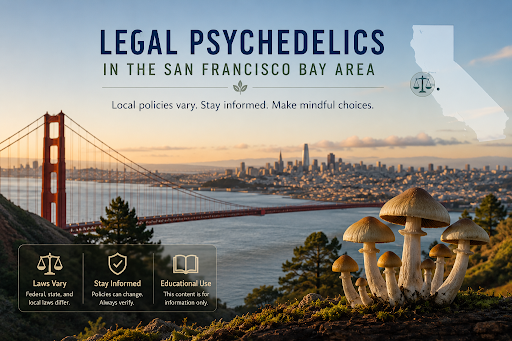
Interest in legal psychedelics has moved well beyond a niche conversation. Across the United States—and especially throughout the San Francisco Bay Area—people are searching for clearer answers about mushroom laws, decriminalization, regulated psilocybin programs, federal psychedelic policy, legal mushroom alternatives, and products found through online dispensaries.
But the phrase “legal psychedelics” can be misleading without context.
A substance can remain controlled under federal law while a city changes local enforcement priorities. A state can establish a regulated psilocybin program without creating a conventional retail market. At the same time, products marketed as mushroom alternatives may contain completely different ingredients and fall under different laws.
Federal policy is also evolving. In 2026, the U.S. Food and Drug Administration finalized guidance for psychedelic-drug clinical investigations, prioritized several psychedelic drug-development programs, and announced additional federal activity focused on potential future therapeutic uses. None of those actions amounts to federal legalization of psilocybin.
For consumers in San Francisco, Oakland, Berkeley, San Jose, Silicon Valley, and surrounding Bay Area communities, understanding these distinctions is much more useful than simply asking whether mushrooms are “legal.”
This guide explains the difference between legalization, decriminalization, regulated access, federal drug development, functional mushrooms, mushroom alternatives, and online dispensary access—and how those categories fit together.
Key Facts / Quick Takeaways
- Psilocybin remains federally controlled in the United States. Increased federal research activity does not amount to general legalization.
- FDA finalized psychedelic clinical-investigation guidance in July 2026, creating clearer recommendations for researchers and drug developers.
- FDA announced priority vouchers in April 2026 for programs studying psilocybin for treatment-resistant depression and major depressive disorder; these are development pathways, not approvals.
- HHS and the Department of Veterans Affairs expanded federal collaboration in July 2026 around potential future FDA-approved psychedelic and rapid-acting mental-health treatments.
- Legalization and decriminalization are different. Decriminalization can reduce enforcement priority without creating a legal retail market.
- There is no single Bay Area psychedelic law. San Francisco, Oakland, Berkeley, San Jose, and neighboring cities may have different local policies.
- Oregon uses a regulated psilocybin-services model, not a conventional take-home dispensary system.
- “Legal mushroom alternative” is a broad term. Functional mushrooms and other mushroom products should not automatically be equated with psilocybin.
- Online availability does not establish legality. A product being available to order does not by itself determine whether it may legally be purchased, received, possessed, or used at the destination.
- Capsules, gummies, chocolates, jellies, and candies are formats—not legal classifications.
What Does “Legal Psychedelics” Actually Mean?
People searching for legal psychedelics, psychedelics that are legal, legal hallucinogens USA, or what psychedelics are legal often want a straightforward list.
The actual legal landscape is more complicated.
A psychedelic or mushroom-related substance can potentially be:
- Controlled under federal law
- Restricted under state law
- Subject to local decriminalization
- Subject to reduced municipal enforcement priority
- Permitted within a state-regulated program
- Available for approved clinical research
- An uncontrolled mushroom product marketed with psychedelic-adjacent terminology
The specific activity matters too.
Possession, cultivation, supervised administration, commercial sale, online ordering, and interstate shipping are separate legal questions.
A local decision affecting personal possession does not necessarily create lawful commercial sales. Similarly, a regulated state psilocybin program does not necessarily permit someone to purchase psilocybin and take it home.
A better way to evaluate a claim about “legal psychedelics” is to ask:
- What substance or active ingredient is involved?
- What does federal law say?
- What does the relevant state law say?
- Has the city or county adopted a separate policy?
- Is the activity legalized, decriminalized, regulated, or simply deprioritized?
- Does the policy cover possession, cultivation, administration, sale, or another activity?
Legalization vs. Decriminalization: Why the Difference Matters
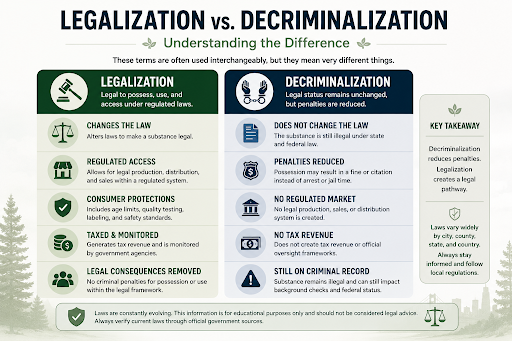
The words legalization and decriminalization are regularly used interchangeably in online discussions of psychedelic laws.
They should not be.
What Is Legalization?
Legalization generally means that an activity previously prohibited has been made lawful within a defined framework.
Legal activity can still be highly regulated. Rules may govern age, licensing, manufacturing, distribution, locations, advertising, or how a substance can be accessed.
What Is Decriminalization?
Decriminalization generally involves reducing criminal penalties or lowering enforcement priority for specified conduct.
A city could make enforcement involving possession of certain entheogenic plants or fungi a lower priority without creating a licensed retail market.
That distinction is fundamental:
Decriminalized does not automatically mean commercially legal.
Nor does a municipal policy change federal law.
What Is Regulated Access?
Regulated access represents a third model.
Instead of conventional retail sales, a government establishes a controlled system in which eligible adults may access a substance under specific conditions.
Oregon’s psilocybin-services framework is a prominent example.
Are Magic Mushrooms Legal in the United States?
At the federal level, psilocybin remains a controlled substance.
That remains true even as federal agencies devote more attention to psychedelic-drug research and potential therapeutic development.
State and local policies, however, are not uniform.
Some jurisdictions have adopted local decriminalization approaches. Others have established regulated systems. These developments can be significant without amounting to nationwide legalization.
Another distinction is equally important:
Not every mushroom product is a psilocybin product.
Functional mushrooms such as lion’s mane, reishi, cordyceps, and turkey tail belong to a different category from psilocybin-containing mushrooms.
Likewise, labels such as “mushroom gummy” or “mushroom chocolate” do not tell a consumer by themselves what active ingredients are present.
When asking whether mushrooms are legal, identify both the substance and the jurisdiction.
Federal Psychedelic Policy Is Evolving
One of the biggest recent changes in the psychedelic landscape is not retail legalization—it is the growing involvement of federal health agencies in psychedelic drug research and development.
That difference deserves careful attention.
FDA Finalized Psychedelic Clinical-Trial Guidance in 2026
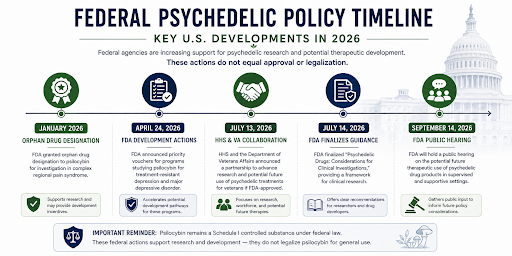
In July 2026, FDA finalized “Psychedelic Drugs: Considerations for Clinical Investigations.”
The guidance gives drug developers recommendations for conducting clinical investigations involving psychedelic drugs, including programs studying potential uses for psychiatric disorders and substance-use disorders.
This is an important federal regulatory development because it provides a more formal framework for evaluating psychedelic medicines.
It does not mean psilocybin has received general FDA approval.
FDA Prioritized Several Psychedelic Drug-Development Programs
In April 2026, FDA announced regulatory actions designed to accelerate the development of treatments for serious mental-health conditions.
Among them were national priority vouchers for companies studying:
- Psilocybin for treatment-resistant depression
- Psilocybin for major depressive disorder
- Methylone for post-traumatic stress disorder
FDA also allowed an early-phase study involving noribogaine hydrochloride to move forward following an Investigational New Drug submission.
These actions are significant for research and regulatory development.
They should not be interpreted as approval of commercially available psilocybin products or as federal legalization for ordinary personal use.
HHS and VA Are Coordinating on Future Psychedelic Treatments
In July 2026, the U.S. Department of Health and Human Services and Department of Veterans Affairs announced a five-year collaboration focused on research, clinical development, workforce preparation, and potential future deployment of rapid-acting psychiatric treatments—including psychedelic drug products if approved by FDA.
The phrase “if approved by FDA” is important.
Federal agencies are preparing for possible future medical applications. They are not announcing unrestricted public access.
FDA Is Also Gathering Public Input
FDA scheduled a September 14, 2026 public hearing focused on the potential future therapeutic use of psychedelic drug products in supervised and supportive settings.
Because this hearing is time-specific, this paragraph should be refreshed after the hearing occurs.
What Do These Federal Developments Actually Mean?
| Federal Development | What It Means | What It Does NOT Mean |
| FDA psychedelic clinical-trial guidance | More formal recommendations for developing and studying psychedelic drugs | Psilocybin is federally legal |
| FDA priority vouchers | Selected development programs may receive regulatory priority | Those psilocybin products are FDA-approved |
| HHS/VA collaboration | Federal agencies are preparing for research and potential future approved therapies | Psychedelics are available as ordinary prescriptions or retail products |
| FDA public hearing | Regulators are considering issues around potential future supervised therapeutic use | A national retail market has been approved |
| Growing federal research | More institutional attention to psychedelic medicines | DEA scheduling has automatically changed |
The federal picture is therefore best described as increasing research, regulatory development, and institutional preparation—not federal legalization.
The Bay Area Psychedelic Landscape
The San Francisco Bay Area has long been associated with psychedelic culture, scientific research, harm reduction, biotechnology, and changing attitudes toward entheogens.
That history sometimes creates the impression that one set of psychedelic laws applies across the entire region.
It does not.
There is no single “Bay Area psychedelic law.”
San Francisco, Oakland, Berkeley, San Jose, and surrounding cities all operate under California and federal law while maintaining their own municipal policies and enforcement priorities.
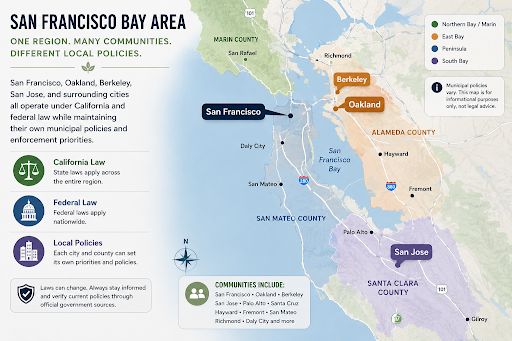
San Francisco
San Francisco has been part of California’s broader policy discussion surrounding entheogenic plants and fungi.
Readers should distinguish local policy and enforcement priorities from state legalization or a licensed commercial psilocybin market.
Someone searching for legal mushrooms in San Francisco should verify what activity a current city policy actually covers.
Oakland
Oakland has played an influential role in national discussions about entheogenic plants and fungi.
That makes the city particularly relevant to searches involving mushroom laws, decriminalization, and local psychedelic policy.
However, reduced local enforcement priority does not automatically authorize unrestricted commercial activity or alter state and federal law.
Berkeley
Berkeley’s City Council records show local consideration and action around de-prioritizing enforcement of laws imposing criminal penalties for certain plant- or fungus-biosynthesized psychedelic drugs for personal use. City materials also make clear that the policy does not itself authorize activities such as distribution or administration.
San Jose and Silicon Valley
People in San Jose and the South Bay frequently encounter information about San Francisco or Oakland while researching mushrooms online.
Those policies should not be assumed to apply automatically to San Jose, Santa Clara County, or Silicon Valley.
What Are Legal Mushroom Alternatives?
The phrase legal mushroom alternative can represent several different consumer intentions.
Some people are looking for non-psilocybin products.
Others are researching functional mushrooms.
Some want a familiar edible or capsule format.
Others may be searching for alternatives to regulated in-person psilocybin services.
These categories should remain distinct.
Functional Mushrooms
Functional mushrooms commonly found in the broader wellness and food marketplace include species such as:
- Lion’s mane
- Reishi
- Cordyceps
- Turkey tail
They should not be presented as substitutes that recreate a psilocybin experience.
Their chemistry, intended use, and expected effects differ.
Mushroom Product Formats
Consumers can also encounter mushroom products in formats such as:
- Capsules
- Gummies
- Chocolates
- Jellies
- Candies
These are formats, not chemical or legal classifications.
A gummy is not inherently psychedelic. A chocolate labeled “mushroom” does not automatically contain psilocybin. Familiar packaging does not establish legality.
Consumers should focus on ingredients, labeling, manufacturer transparency, available testing documentation, and the law applicable to their jurisdiction.
What Are Legal Hallucinogens?
Search terms such as legal hallucinogens, legal hallucinogens USA, and what hallucinogens are legal create another terminology challenge.
There is no simple nationwide list of unrestricted substances that can safely be described as “legal psychedelic drugs.”
Different compounds have different regulatory classifications.
Some products using psychedelic or mushroom-related language may not contain a traditional psychedelic at all.
Useful questions include:
- What are the active ingredients?
- Are they clearly disclosed?
- Is testing documentation available?
- Who manufactured the product?
- What jurisdiction will the product enter?
- What laws apply there?
- Is the word “legal” supported by law, or simply being used as marketing language?
Marketing language does not determine legal status.
Looking for a Schedule 35 Alternative?
Searches for a Schedule 35 alternative may reflect a desire for something broader than a direct product substitute.
Someone using this phrase may be looking for:
- An alternative to an in-person mushroom experience
- Online dispensary access
- Different product formats
- Non-psilocybin options
- Options outside Oregon
- A simpler product-research experience
- Information about different psychedelic-access models
The important question is what part of the model the person is trying to replace.
Oregon Psilocybin Services Are Not a Conventional Dispensary Model
Oregon provides a useful comparison because its program is highly structured.
Oregon Health Authority states that licensed service centers are the locations where administration sessions occur and describes them as the only places where clients can legally purchase and consume psilocybin within that program. The agency explicitly says this is not a dispensary model.
That model is fundamentally different from ordinary online retail.
A product available through an online dispensary should therefore not be described as legally equivalent to Oregon’s regulated psilocybin-services framework.
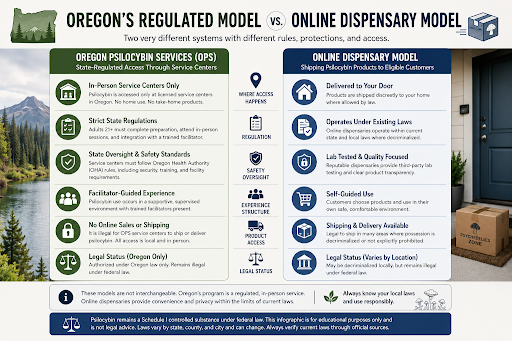
Oregon Regulated Services vs. Online Mushroom Options
| Factor | Oregon Psilocybin Services | Online Mushroom / Psychedelic-Adjacent Products |
| Regulatory model | State-regulated services | Depends on ingredients and jurisdiction |
| Access | Licensed service center | Online ordering where offered |
| Psilocybin consumption | At licensed service center | Do not assume shipment or possession is lawful |
| Facilitator | Licensed facilitator involved | Generally not part of conventional online retail |
| Take-home model | Not the conventional Oregon service model | Product and jurisdiction dependent |
| Geographic scope | Oregon | Seller and destination dependent |
| Main consideration | Compliance with regulated service framework | Ingredients, product identity, testing, shipping rules and applicable law |
Is It Legal to Buy Magic Mushrooms Online?
Searches such as “is it legal to buy magic mushrooms online,” “is buying magic mushrooms online legal,” “legal psychedelics online,” and “buy psychedelics in legal way” often mix two separate questions:
Can a product be ordered online?
and
Is that product lawful to purchase, ship, receive, possess, and use at the destination?
Those are not equivalent.
A website’s ability to accept an order does not establish the legal status of a controlled substance in your state.
Consumers researching products from an online dispensary should identify the actual ingredients, review labeling and available testing information, understand shipping restrictions, and verify applicable law.
Online availability should not be treated as proof of legality.
How to Evaluate an Online Mushroom Dispensary
Bay Area consumers comparing mushroom products online can use several transparency signals.
Clear Ingredient Information
Consumers should be able to understand what they are considering.
Broad terms such as “mushroom blend” should not replace meaningful ingredient information.
Testing Transparency
When laboratory documentation is provided, review what was actually tested.
Testing may provide useful quality information.
It does not determine legal status.
Familiar Product Formats
Psychedelics Zone’s online dispensary includes formats such as capsules, gummies, chocolates, jellies, and candies.
These familiar formats can make product categories easier to understand, but no format should be assumed to be inherently legal, risk-free, or appropriate for every person.
Brand Transparency
Formats available through Psychedelics Zone include products associated with MycroChips, CUCU & MELO, HÉRO, and Made in Space.
The safer way to compare products is to focus on ingredient transparency, labeling, format, available testing information, and relevant precautions rather than selecting products based on promises of intensity.
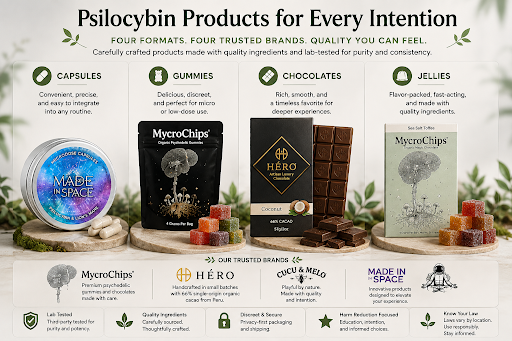
Mushroom Product Formats: What Changes and What Doesn’t
The physical format of a product can affect how it is handled or experienced, but it does not determine its legality.
| Format | Mechanism / Form | Onset | Intensity | Duration | Primary Risks | Format Consideration | Key Considerations |
| Capsules | Encapsulated ingredients | Ingredient and digestion dependent | Product dependent | Product dependent | Unknown ingredients, mislabeling, sensitivity | Standardized physical format | Verify ingredients and testing |
| Gummies | Chewable edible | Formulation and digestion dependent | Product dependent | Product dependent | Candy-like appearance, accidental consumption | Familiar edible format | Labeling and secure storage |
| Chocolates | Chocolate edible | Digestion and formulation dependent | Product dependent | Product dependent | Portion assumptions, unclear formulation | Familiar food format | Review complete ingredient panel |
| Jellies | Soft edible | Formulation dependent | Product dependent | Product dependent | Similar edible-product concerns | Soft edible preference | Ingredient transparency |
| Candies | Confection format | Formulation dependent | Product dependent | Product dependent | Accidental consumption and ambiguous branding | Portable/familiar format | Secure storage |
| Functional mushrooms | Food, powder, capsule or extract | Not comparable to psilocybin | Not a psilocybin-equivalent category | Product dependent | Quality differences, allergies, interactions | Non-psychedelic mushroom interest | Species and ingredients |
Important: Format alone does not determine potency, safety, legality, or whether a product contains psilocybin.
Harm-Reduction Considerations
For Capsules
Capsules provide a standardized physical format, but visually similar capsules can contain very different ingredients.
Read the complete label and review available testing information.
For Gummies, Chocolates, Jellies and Candies
These formats can resemble conventional food or candy.
Products intended for adults should be clearly labeled, securely stored, and kept away from children and pets.
Do not use appearance or flavor to estimate psychoactive effects.
For Potentially Higher-Intensity Experiences
Psychoactive experiences can be unpredictable.
Individual sensitivity, environment, mindset, medications, other substances, and underlying health considerations can influence effects.
Anyone with concerns about medications or medical or psychiatric conditions should discuss potential interactions with an appropriately qualified healthcare professional.
Never stop, skip, or change prescribed medication simply to alter a psychedelic experience.
General Harm-Reduction Principles
- Know what a product contains.
- Review labels and available testing documentation.
- Avoid combining unfamiliar psychoactive substances.
- Do not drive or operate machinery while impaired.
- Use a safe environment if consuming something that may alter perception.
- Keep adult products away from children and pets.
- Consider potential medication and substance interactions.
- Seek urgent medical assistance for severe or concerning symptoms.
- Verify applicable law instead of relying on marketing claims.
Bay Area Online Dispensary Access
For customers researching mushroom products in San Francisco, Oakland, Berkeley, San Jose, Silicon Valley, and surrounding Bay Area communities, Psychedelics Zone operates as an online dispensary rather than a conventional walk-in retail storefront.
That allows customers to research product formats and shipping options remotely.
Psychedelics Zone also serves a broader U.S. audience through nationwide shipping availability, subject to applicable restrictions.
The legal distinction remains important:
Shipping availability does not establish that every product is lawful in every destination.
Frequently Asked Questions
What psychedelics are legal in the United States?
There is no single nationwide category of unrestricted “legal psychedelics.” Different substances are governed by different federal and state laws, while some jurisdictions have established local decriminalization policies or regulated-access programs. Always identify the substance, activity, and location being discussed.
Has the federal government approved psilocybin?
Not for general therapeutic or retail use. FDA has increased its involvement in psychedelic-drug development, including final clinical-investigation guidance and priority actions involving certain psilocybin research programs. Those steps concern drug development and potential future approvals—not general federal legalization of psilocybin.
Are magic mushrooms legal in California?
California does not have a general statewide recreational retail market for psilocybin. Local municipal policies should be evaluated separately from state and federal law.
Are mushrooms legal in San Francisco or Oakland?
It depends on the type of mushroom and activity involved. Functional mushrooms and psilocybin-containing mushrooms are different legal categories. Local entheogenic policies should not automatically be interpreted as commercial legalization.
Is it legal to buy magic mushrooms online?
Online availability does not establish legality. Laws concerning purchase, shipping, possession, distribution, and use can differ. Consumers should identify the ingredients and verify the rules applicable to their destination.
What is a legal mushroom alternative?
The phrase can refer to functional mushrooms, non-psilocybin mushroom products, or other mushroom and psychedelic-adjacent options. A legal mushroom alternative should not automatically be assumed to reproduce psilocybin’s effects.
What are legal hallucinogens?
There is no simple national list of unrestricted “legal hallucinogens.” Different substances have different legal classifications, and some products marketed with psychedelic terminology may contain ingredients other than traditional psychedelics.
Is Oregon psilocybin the same as buying mushrooms from a dispensary?
No. Oregon Health Authority describes its model as a regulated psilocybin-services system and explicitly states that licensed service centers are not a conventional dispensary model.
What is a Schedule 35 alternative?
Someone searching for a Schedule 35 alternative may be looking for different mushroom formats, non-psilocybin options, online access, or an alternative to an in-person service-center model. An alternative product should not be assumed to have the same ingredients, effects, or legal status as a regulated psilocybin service.
Does Psychedelics Zone ship outside the Bay Area?
Psychedelics Zone operates as an online dispensary serving the Bay Area and a broader nationwide audience through shipping, subject to applicable restrictions. Shipping availability does not determine whether a specific product is lawful in a customer’s jurisdiction.
How should I evaluate an online mushroom dispensary?
Look for transparent ingredient information, clear labeling, testing documentation where available, identifiable brands, shipping policies, appropriate age restrictions, and straightforward legal and safety information. Be cautious of blanket claims that a product is “legal everywhere.”
The Bottom Line: Federal Progress Does Not Eliminate Local Legal Differences
Interest in legal psychedelics, legal hallucinogens, legal mushroom alternatives, psychedelic laws, and online mushroom dispensaries continues to grow.
Federal agencies are now treating psychedelic drug development with considerably more formal regulatory attention than in previous years.
FDA has finalized psychedelic clinical-trial guidance. Selected psilocybin development programs have received regulatory priority. HHS and VA are coordinating around potential future approved treatments. Federal officials are actively discussing how psychedelic medicines might eventually fit into supervised healthcare environments.
But none of that eliminates the distinction between research, drug approval, scheduling, decriminalization, regulated access, and legalization.
For Bay Area consumers, geography still matters.
San Francisco policy does not automatically determine Oakland policy. Oakland policy does not automatically govern Berkeley. Those local approaches do not automatically apply in San Jose or throughout California.
Products require the same level of attention.
Capsules, gummies, chocolates, jellies, candies, functional mushrooms, and other mushroom-related products can look similar while containing very different ingredients.
Psychedelics Zone serves Bay Area customers and a broader U.S. audience as an online dispensary, providing multiple mushroom-product formats and educational resources.
Convenient online access should be paired with informed decision-making rather than assumptions about legality.
Know the product. Know the jurisdiction. Know the difference between availability, decriminalization, regulated access, drug approval, and legalization.
Explore our guide to legal mushroom alternatives
Legal, Safety & Age Disclaimer
This article is provided for general educational and harm-reduction purposes and does not constitute medical or legal advice.
Laws involving psilocybin, entheogenic plants and fungi, psychoactive products, shipping, possession, commercial activity, and regulated services vary by jurisdiction and can change.
Local decriminalization does not necessarily constitute legalization, authorize commercial sales, or change federal law.
Recent FDA, HHS, or other federal actions concerning psychedelic research or drug development should not be interpreted as general FDA approval or federal legalization of psilocybin.
Readers should consult current government sources or appropriately qualified legal counsel when legal status affects a decision.
Product effects vary according to ingredients and individual circumstances. People taking prescription medications or managing medical or psychiatric conditions should discuss potential interactions with an appropriately qualified healthcare professional.
Never discontinue, skip, or alter prescribed medication for the purpose of using a psychedelic substance without guidance from the prescribing clinician.
Products intended for adults should be securely stored away from children and pets. Follow applicable age requirements and laws.