
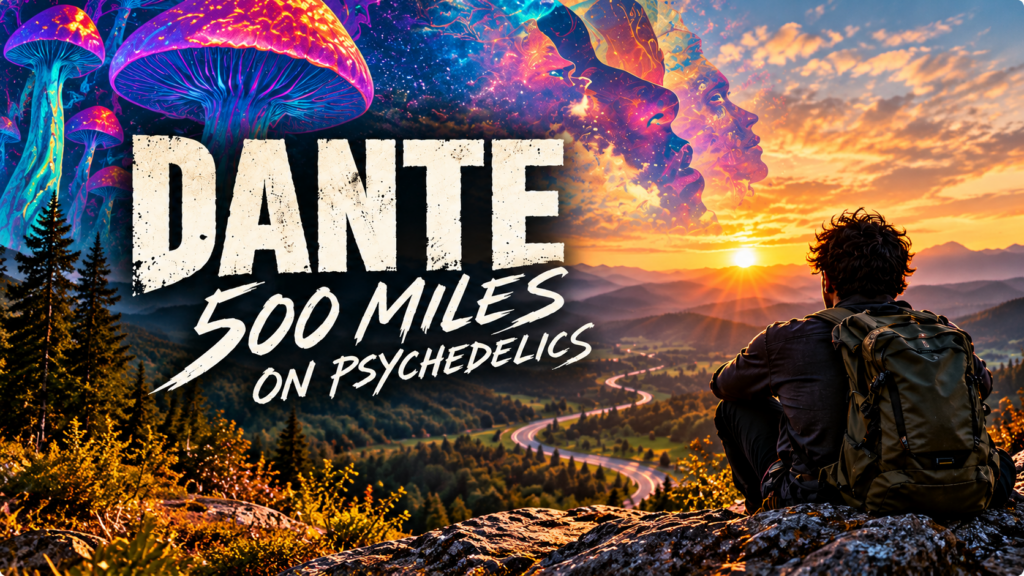
An educational look at the documentary, its extraordinary endurance journey, the science behind psychedelics, and the safety questions viewers should understand.
Introduction
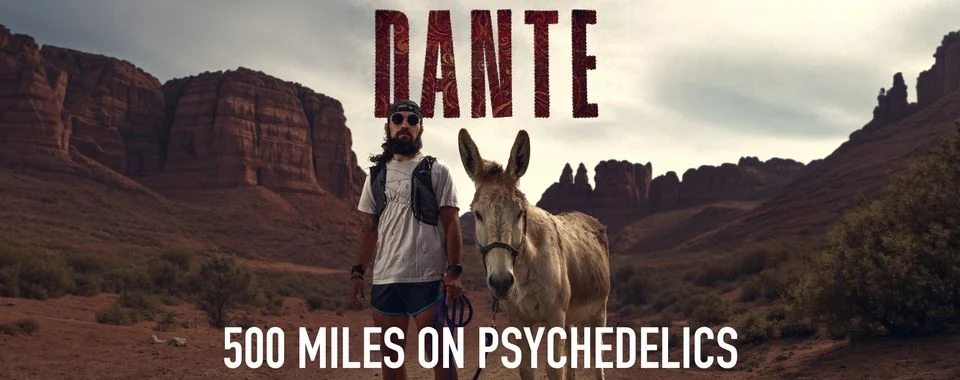
What happens when an endurance athlete attempts to run 500 miles through the desert while using psychedelics? That provocative question sits at the center of Dante: 500 Miles on Psychedelics, a documentary exploring physical limits, psychological struggle, personal redemption, and unconventional ideas about healing.
Directed by Fernando Gonzalez and featuring Dante Liberato, the film follows a grueling desert-running challenge that raises questions far beyond athletic performance. It asks viewers to consider how psychedelic experiences intersect with identity, resilience, personal transformation, and the human desire to overcome adversity.
For audiences searching for the Dante documentary, the story is compelling on its own. But it also opens an important conversation about the difference between personal experience, scientific evidence, and responsible psychedelic education.
At Psychedelics Zone, an online dispensary focused on psychedelic product information and consumer education, we believe that conversation deserves nuance. A remarkable personal story is not the same as a clinical study, and an extreme endurance challenge should never be mistaken for a general safety recommendation.
This guide explains what the film is about, where to watch it, what psychedelic science actually tells us, and why understanding psychological risks—including psychosis—is essential to an informed discussion.
Key Facts: Dante and the Science Behind Psychedelics
Dante: 500 Miles on Psychedelics is a 2026 American documentary.
The film features Dante Liberato and is directed by Fernando Gonzalez.
Its central story involves a 500-mile desert-running challenge and psychedelic use.
The official runtime is 105 minutes, or 1 hour and 45 minutes.
The film is distributed for online viewing through Eventive.
Its themes include endurance, personal struggle, redemption, and psychedelic stigma.
Psychedelics can alter perception, emotions, and thinking; their effects are not uniformly positive.
Psilocybin is being investigated in clinical research, but investigational use does not establish that an ordinary commercial product is FDA-approved.
Psychedelic substances can present psychological risks, including potentially serious reactions among vulnerable individuals.
Psilocybin remains federally controlled under Schedule I in the United States.
What Is Dante: 500 Miles on Psychedelics About?
At its core, Dante: 500 Miles on Psychedelics is an endurance documentary with a psychological dimension.
The film follows Dante Liberato as he attempts a 500-mile journey through challenging desert terrain while using psychedelics. The official synopsis frames the effort as both a physical and internal struggle, with the protagonist confronting personal difficulties while pursuing redemption and testing the limits of human potential.
The documentary was produced by SFFR FILMS and directed by Fernando Gonzalez. Its premise places it at the intersection of adventure filmmaking, personal storytelling, and contemporary psychedelic culture.
A story about more than running
The film’s premise is striking because it combines three subjects that are usually discussed separately: extreme physical endurance, psychological resilience, and psychedelic experiences.
Long-distance endurance challenges already involve considerable uncertainty. Fatigue, dehydration, changing environmental conditions, and sleep disruption can affect judgment and physical performance.
Introducing psychoactive substances into such an environment adds another layer of unpredictability.
This makes the documentary a useful starting point for conversations about personal motivation and risk. It does not establish that psychedelics improve endurance, make difficult activities safer, or enhance athletic performance.
Challenging stigma without dismissing risk
Another important theme is the stigma surrounding psychedelics and unconventional approaches to healing.
The documentary’s framing invites viewers to question established assumptions. However, responsible discussion requires distinguishing social stigma from legitimate scientific and medical concerns.
A substance can be the subject of promising research and still carry meaningful risks. Personal accounts may inspire scientific questions, but they cannot independently establish safety or effectiveness.
That distinction is particularly important for viewers who discover the film through social media and want to learn more about psychedelic substances afterward.

Where Can You Watch Dante: 500 Miles on Psychedelics?
For viewers searching “Dante 500 miles on psychedelics where to watch,” the most direct option is the film’s official streaming page.
Official viewing options
The film’s official online viewing listing
View film
Official film website and trailer
Filmmaker information and streaming updates
Visit site
At the time of this review, the official film website identifies the documentary as available to stream worldwide, while Eventive provides the viewing page. Availability, access requirements, and rental terms may change.
Why Is the Dante Documentary Generating Interest?
The film arrives during a period of increasing public attention to psychedelic research, mental health, personal transformation, and nontraditional approaches to well-being.
Its subject also combines two naturally engaging narratives: an extraordinary athletic challenge and a controversial scientific and cultural topic.
The Google Trends data supplied for this article identifies several related searches as “Breakout,” including the film title, its shortened name, and viewing-related queries.
In Google Trends, “Breakout” generally indicates exceptionally rapid relative growth from the comparison period. It does not establish how many people searched or whether interest will remain elevated.
That distinction matters when evaluating a documentary-driven search opportunity.
Three reasons viewers may be interested
First, the 500-mile challenge is an inherently unusual endurance story. Even without the psychedelic component, a desert-running documentary presents questions about perseverance and personal limits.
Second, the psychedelic premise introduces controversy and curiosity. Viewers may wonder what substances were involved, how they affect perception, and whether the documentary’s experiences reflect broader scientific findings.
Third, the film’s emphasis on redemption and psychological struggle connects with public conversations about mental health.
These interests overlap, but they should not be treated as identical. Someone searching for the film may simply want to watch it, while another reader may be looking for a reliable explanation of psychedelic effects.
A useful educational article should serve both readers without confusing entertainment with clinical evidence.
What Are Psychedelics, and How Do They Affect the Brain?
Psychedelics are a group of psychoactive substances associated with changes in perception, thought, emotional experience, and sensory processing.
Classic psychedelics include psilocybin and LSD. Their effects involve serotonin signaling, particularly the 5-HT2A receptor.
Psilocybin is a naturally occurring compound found in certain mushroom species. After entering the body, it is converted into psilocin, which contributes to its psychoactive effects.
Researchers study these compounds because their effects on cognition and perception may help scientists understand brain function and investigate possible clinical applications.
However, psychedelic experiences vary considerably between individuals.
Commonly reported effects
People may report altered visual or sensory perception, intensified emotions, changes in the experience of time, unusual associations between ideas, or heightened introspection.
Not all experiences are comfortable. Anxiety, fear, confusion, and disorientation can also occur.
The same person may respond differently across occasions because psychological state, environment, substance composition, medical history, and other factors can influence the experience.
Encyclopaedia Britannica’s overview of psilocybin
What does the film tell us about psychedelic performance?
The documentary illustrates one individual’s extraordinary challenge. It should not be interpreted as proof that psychedelics improve running, stamina, recovery, or physical endurance.
Research designed to answer such questions would need controlled methods, objective measurements, and appropriate safety monitoring.
A documentary does not provide those controls.
For viewers interested in the film’s larger themes, the distinction is straightforward: personal experience can be meaningful without establishing a generally applicable scientific conclusion.
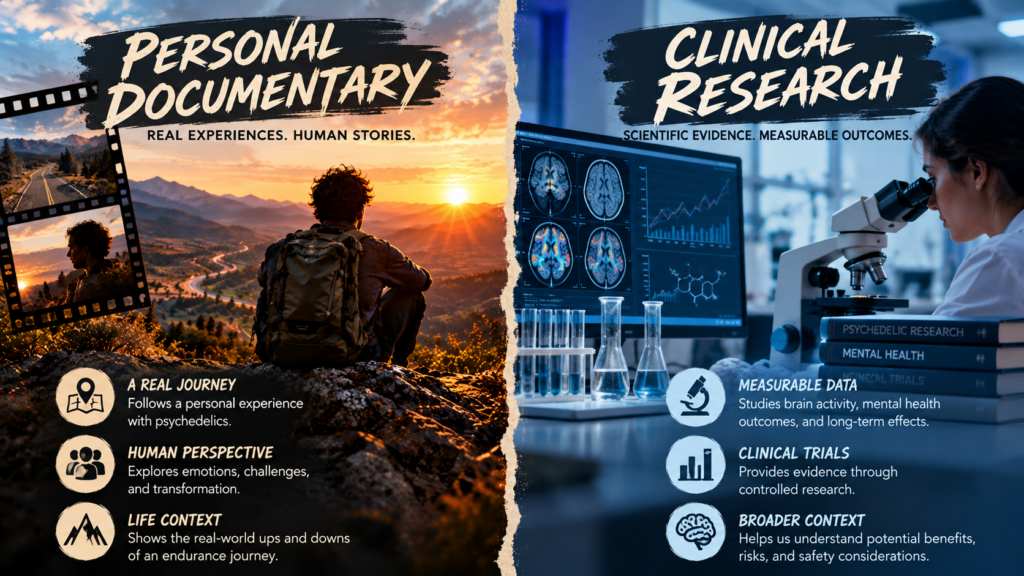
Documentary Experiences vs. Clinical Psychedelic Research
Factor | Dante documentary | Clinical psychedelic research |
Primary purpose | Tell a personal endurance and redemption story | Investigate specific scientific or medical questions |
Environment | Extreme desert-running conditions | Defined research setting |
Participants | Individual featured subject | Selected research participants |
Safety oversight | Film-specific arrangements not independently established here | Protocol-defined screening and monitoring |
Evidence produced | Personal narrative and documentary footage | Structured observations and study outcomes |
Conclusions | Insight into an individual’s experience | Findings limited by study design and evidence |
Generalizability | Cannot establish population-wide effects | Depends on sample size, controls, and replication |
This comparison is important because the public often encounters psychedelic research through personal stories before reading scientific literature.
A compelling account may motivate curiosity, but it cannot substitute for controlled investigation.
Psychedelics, Mental Health, and the Risk of Psychosis
One of the most important related searches in the supplied Google Trends screenshot is “psychosis,” which showed a 90% increase in the selected comparison.
That does not establish that viewers of Dante are experiencing psychosis or that the film itself is causing concern. It does, however, identify an important educational subject that fits naturally within a broader discussion of psychedelic safety.
What is psychosis?
Psychosis describes a collection of symptoms involving a disruption in how someone perceives or interprets reality.
Symptoms can include hallucinations, delusions, and confused or disorganized thinking.
Psychosis is not a single diagnosis. It may occur in association with certain psychiatric conditions, medical problems, substance effects, or other circumstances.
The UK’s National Health Service identifies substance use, including psilocybin and LSD, among possible triggers for psychotic episodes.
Psychosis
NHS guide to the causes of psychosis
NHS explanation of psychosis symptoms
Does psilocybin cause psychosis?
The relationship is complex.
Psilocybin can produce temporary perceptual changes that resemble some features of psychosis, but a psychedelic experience and a psychotic disorder are not the same thing.
Substance-associated psychotic episodes are possible, particularly where underlying vulnerabilities or additional risk factors exist. However, the likelihood of a serious outcome cannot be determined from a documentary, and research findings from carefully screened clinical participants should not be generalized to unsupervised use.
Individuals with personal or family histories of psychotic disorders or bipolar disorder warrant particular caution and professional assessment.
Warning signs that require attention
Persistent confusion, severe paranoia, fixed beliefs disconnected from reality, dangerous behavior, or hallucinations continuing beyond expected intoxication effects warrant prompt medical evaluation.
A person experiencing these symptoms should not be left alone in an unsafe environment. If someone is in immediate danger, emergency services should be contacted.
For readers looking for further clinical context, Mayo Clinic’s mental-health educational resources and the NHS psychosis materials provide more appropriate starting points than social-media speculation.
What the Dante Film Teaches Us About Harm Reduction
The documentary’s unusual premise creates an opportunity to discuss why psychedelic harm reduction matters.
The most responsible lesson is not to recreate the challenge. It is to recognize that combining altered perception with physical danger can introduce serious risks.
Physical environments matter
Extreme heat, remote terrain, dehydration, fatigue, and difficult navigation can all create hazards independently.
When perception or judgment is altered, recognizing and responding to those hazards may become more difficult.
For that reason, readers should not attempt to reproduce the film’s combination of psychedelic use and extreme endurance activity.
Psychological preparation matters
A person’s mental state, expectations, and environment can influence how a psychedelic experience unfolds.
Stress, sleep deprivation, and pre-existing mental-health concerns may complicate the experience.
Clinical psychedelic research uses screening and structured procedures precisely because participant safety cannot be assumed.
Substance identification matters
The word “psychedelic” covers multiple compounds with different pharmacological characteristics.
Commercial mushroom products may also vary in ingredients, labeling, and composition. A gummy, chocolate, capsule, or candy should not be assumed to contain psilocybin simply because its packaging uses mushroom imagery.
Consumers should evaluate ingredient disclosures and independent testing documentation critically, where available.
Medication interactions matter
Some medications may interact with psychedelic substances or affect their effects.
People taking psychiatric medications should speak with a qualified clinician before considering psychedelic exposure. Prescribed medications should never be stopped, skipped, or changed to intensify a psychedelic experience.
How GLP-1 medications and SSRIs may interact with psilocybin.
How Different Psychedelic Product Formats Compare
The Dante documentary focuses on an extraordinary personal experience, but many readers arriving through psychedelic-related searches may also encounter consumer products presented in different forms.
Understanding those formats is part of basic consumer literacy.
Format | Typical physical presentation | Main consumer consideration |
Capsules | Encapsulated powder or extract | Ingredient identity and labeled contents |
Gummies | Chewable edible | Potential confusion with ordinary candy |
Chocolates | Chocolate-based edible | Ingredient disclosure and storage |
Jellies | Soft edible pieces | Clear labeling and child-resistant storage |
Candies | Sweet confectionery | Risk of accidental ingestion |
The format alone does not establish the identity, potency, safety, or legal status of a product.
An attractive package or familiar edible presentation is not evidence that its contents are suitable for everyone.

How This Conversation Connects to Psychedelics Zone
Psychedelics Zone operates as an online dispensary, providing a digital setting for consumers to explore mushroom-related product categories and educational information rather than a conventional walk-in storefront.
The connection between the Dante documentary and PZ is educational: both sit within a broader public conversation about psychedelics, consumer understanding, and responsible decision-making.
PZ’s catalog includes brands such as MycroChips, HÉRO, CUCU & MELO, and Made in Space, with product-format discussions covering capsules, gummies, chocolates, jellies, and candies.
These brands and formats should not be interpreted as equivalent to substances depicted in the documentary or to investigational products used in clinical trials.
Readers interested in learning about product categories should prioritize transparent ingredient information, reliable labeling, secure storage, and applicable legal restrictions.
Psychedelics Zone online product catalog
Capsule product format information
Gummy product format information
Chocolate product format information
For readers interested in location-specific information, PZ also maintains city-focused pages. Such pages should explain relevant service information without suggesting that a local decriminalization policy makes commercial psilocybin transactions lawful.
Federal Psychedelic Research and Legal Status
Regulatory review: October 13, 2026. This section should be reviewed periodically.
Federal interest in psychedelic research has expanded, but scientific investigation and general commercial legality are different matters.
In July 2026, the FDA finalized its guidance on psychedelic clinical investigations. The guidance addresses research design and considerations for developers investigating psychedelic drugs for possible medical applications.
The FDA also maintains a dedicated psychedelic-drug development information page covering research initiatives, regulatory guidance, and agency activities.
These developments do not mean that all psychedelic substances or commercially available mushroom products have received FDA approval.
Separately, the DEA continues to identify psilocybin as a Schedule I controlled substance under federal law.
State programs and municipal decriminalization policies must be evaluated separately. Decriminalization does not necessarily authorize retail sales, interstate shipping, or commercial distribution.
Online availability likewise does not determine whether a particular transaction is lawful.
Frequently Asked Questions About Dante: 500 Miles on Psychedelics
1. What is Dante: 500 Miles on Psychedelics about?
It is a documentary about Dante Liberato undertaking a 500-mile desert-running challenge involving psychedelics. The film explores endurance, personal struggles, redemption, and public attitudes toward unconventional healing.
2. Where can I watch Dante: 500 Miles on Psychedelics?
The documentary is listed for online viewing through Eventive. Viewers can also visit the official website, Dante500.com, for its trailer and current distribution information.
3. Who is Dante in the documentary?
Dante Liberato is the featured subject of the film. The documentary follows his desert endurance challenge and the personal struggles associated with the journey.
4. Who directed the Dante documentary?
Fernando Gonzalez directed Dante: 500 Miles on Psychedelics. SFFR FILMS is credited as the production studio.
5. How long is Dante: 500 Miles on Psychedelics?
The documentary runs for approximately 105 minutes, or 1 hour and 45 minutes.
6. Is the Dante documentary based on a true story?
The film is presented as a nonfiction documentary centered on Dante Liberato’s endurance journey. Its official synopsis describes a 500-mile desert run. That does not mean every interpretation or implication presented in the film has been independently established through scientific research.
7. Does the film prove psychedelics improve athletic performance?
No. A documentary about an individual’s experience does not establish that psychedelic substances improve endurance, speed, recovery, or athletic performance. Those claims would require appropriate scientific evidence.
8. Can psychedelics cause psychosis?
Substance-associated psychotic episodes are possible, although risk varies across individuals and circumstances. People with relevant psychiatric vulnerabilities should seek professional guidance and avoid assuming that experiences described in documentaries or online testimonials are safe to reproduce.
9. Are psilocybin mushrooms legal in the United States?
Psilocybin remains a Schedule I controlled substance under federal law. Certain states and local jurisdictions have adopted different policies or regulated frameworks, but those policies do not create nationwide legalization or unrestricted commercial access.
10. What is the difference between psychedelic research and recreational use?
Clinical research follows study protocols that may include participant screening, monitoring, defined investigational substances, and data collection. Unsupervised recreational use does not provide the same safeguards or produce equivalent scientific evidence.
11. Is the documentary connected to Psychedelics Zone?
No official affiliation between the film and Psychedelics Zone is established here. PZ discusses the documentary as part of its broader educational coverage of psychedelics, public interest, consumer safety, and harm reduction.
12. What should viewers learn from the documentary?
The film offers a personal story about endurance and transformation. Its broader educational value lies in encouraging questions about psychedelic science, individual risk, mental health, and the difference between personal testimony and clinical evidence.
The Bottom Line
Dante: 500 Miles on Psychedelics offers an unusual documentary premise: an endurance athlete, a 500-mile desert journey, and an exploration of personal transformation through psychedelics.
For viewers interested in documentary filmmaking, the story raises compelling questions about human resilience and the boundaries of physical and psychological experience.
For readers interested in psychedelic science, the more important takeaway is that remarkable personal experiences and scientific evidence serve different purposes.
Psychedelics are being investigated in clinical settings, but their risks, regulatory status, and effects require careful consideration.
Psychedelics Zone supports a more informed conversation by emphasizing education, transparent product information, and harm-reduction principles rather than encouraging readers to reproduce extreme experiences.
Important Legal, Medical, and Safety Disclaimer
This article is for general education and film commentary only. It does not provide medical or legal advice, endorse psychedelic use, or recommend attempting endurance activities while intoxicated.
Psilocybin remains federally controlled in the United States. State and local laws vary, and decriminalization, regulated access, and commercial legality are not interchangeable. Online availability does not establish legality.
Psychedelic substances may cause serious adverse psychological reactions. Anyone with mental-health concerns, relevant personal or family psychiatric history, or questions about medication interactions should consult an appropriately qualified healthcare professional. Never stop or alter prescribed medication without clinical guidance.
Products intended for adults should be stored securely away from children and pets. Follow applicable age requirements and local laws.