
Last Updated: September 2026
People searching for mushroom delivery in San Diego are often looking for an easy online ordering option, but Psychedelics Zone serves San Diego through mushroom shipping, not a locally dispatched courier. San Diego itself stretches across one of California’s most varied urban coastlines—from sandstone bluffs and rare Torrey pine habitat in the north to La Jolla, Mission Bay, the Downtown waterfront, Balboa Park and neighborhoods extending all the way toward the international border. Psychedelics Zone is an online dispensary where San Diego customers can compare current mushroom gummies, mushroom chocolates, capsules, drink mixes and other verified formats before placing an eligible order for shipment.
There is no Psychedelics Zone storefront, warehouse, pickup location, locally stocked inventory or same-day San Diego courier represented by this page.
Explore the Psychedelics Zone Shop →
Review Current Shipping Information →
Mushroom Delivery San Diego Searches: What Psychedelics Zone Actually Provides
The phrase mushroom delivery San Diego reflects local transactional search intent.
Psychedelics Zone’s actual fulfillment method is shipping.
The current Shipping Policy states that orders are processed within 1–2 business days and that typical delivery is 3–7 business days after shipment. USPS and UPS are the primary carriers listed, and the current policy says Psychedelics Zone ships to all 50 U.S. states.
Orders currently ship in plain, discreet exterior packaging without product details visible outside. P.O. boxes, APO and FPO addresses are excluded.
Read the Psychedelics Zone Shipping Policy →
San Diego’s housing ranges from detached coastal and suburban homes to Downtown towers, student housing, apartments, condominiums and large managed communities.
Depending on the destination, a parcel may be handled through a front porch, shared mailroom, locker, leasing office, concierge, property manager or another receiving system.
Discreet packaging is not the same thing as guaranteed private receipt.
Psychedelics Zone controls the exterior of the parcel. It does not control carrier handling or what happens after a shipment reaches a building, university mailroom or other third-party receiving point.
San Diego’s Geography Starts With the Pacific
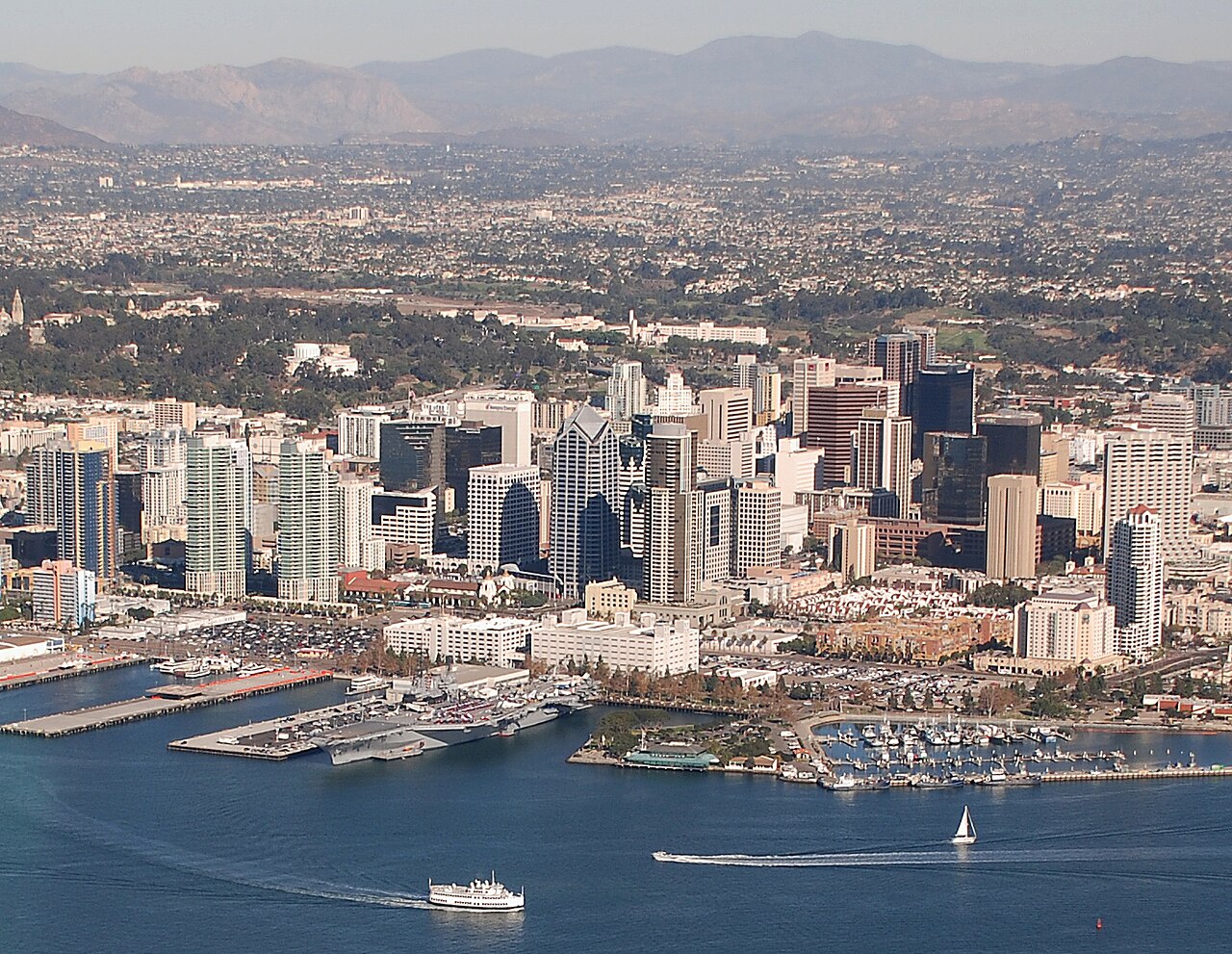
San Diego is not a city with one waterfront.
Its coastal geography changes repeatedly.
Northwestern San Diego includes Torrey Pines and La Jolla.
Farther south are Pacific Beach, Mission Beach and Ocean Beach.
Point Loma separates the Pacific from San Diego Bay.
Inside the Bay, Downtown faces the Embarcadero.
Then the city continues south through neighborhoods such as Barrio Logan, Otay Mesa and San Ysidro.
The City maintains 49 community plans covering 52 community planning areas, which helps explain why San Diego operates less like one compact core and more like a network of highly distinct communities.
That scale is crucial to this page.
La Jolla is San Diego.
Mission Bay is San Diego.
Downtown is San Diego.
San Ysidro is San Diego.
But nearby cities such as Del Mar, Coronado, Chula Vista and National City are separate municipalities.
Torrey Pines Is San Diego’s Coastal-Bluff Bookend
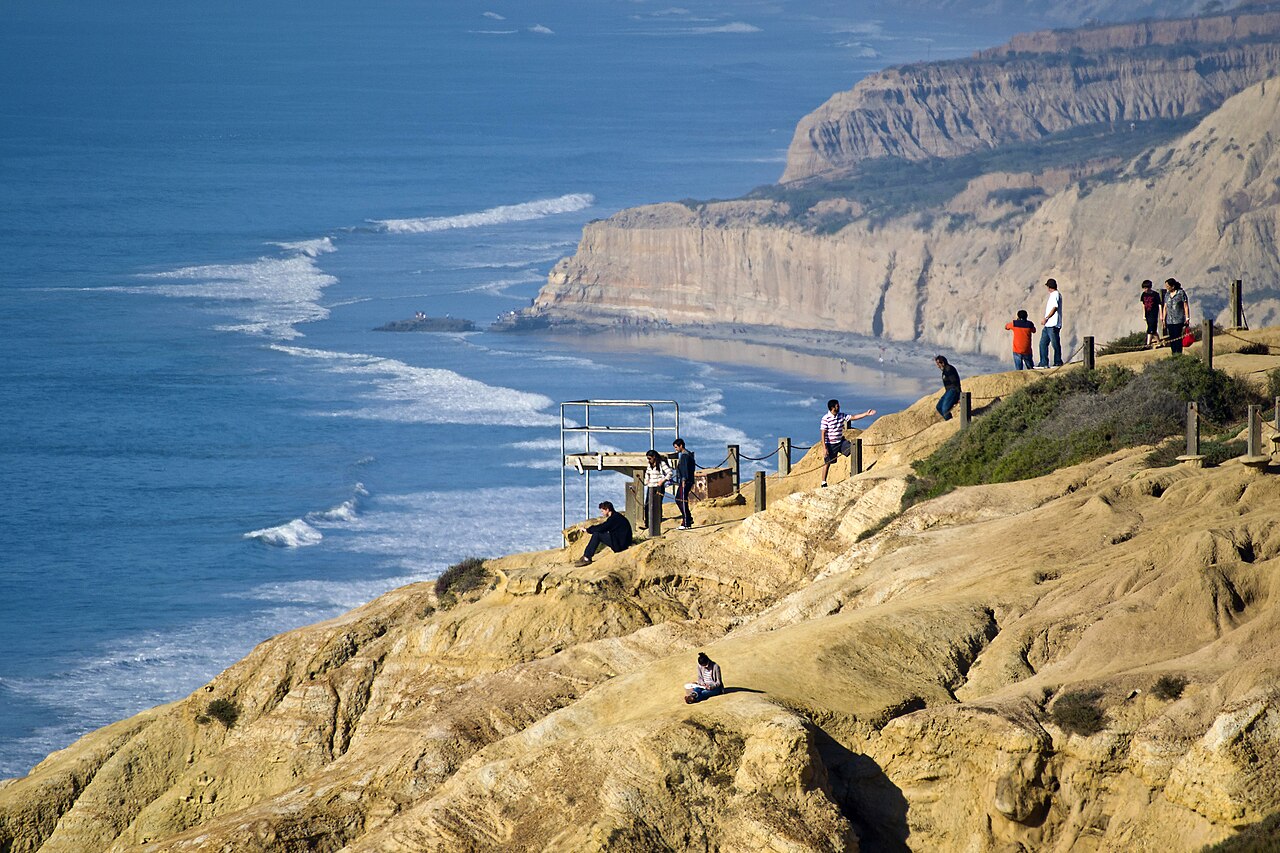
At the northwestern edge of the city, Torrey Pines gives San Diego one of its most dramatic landscapes.
The City describes the Torrey Pines community as roughly 2,600 acres, bordered by the Pacific Ocean on the west and Interstate 5 on the east. About 1,000 acres are open space, including lagoons, wetlands, canyons, sandstone bluffs and native Torrey pines.
Torrey Pines State Beach and the State Natural Reserve occupy part of this coastal environment.
The value here is geographic.
A San Diego page that begins only with Downtown misses the fact that the city includes rugged, protected Pacific coastline.
The landscape at Torrey Pines feels almost removed from the dense urban region surrounding it.
Outdoor locations are included to explain San Diego. Do not combine intoxicating products with surfing, swimming, cycling, hazardous hiking, driving, gliding or other activities requiring coordination and alertness.
La Jolla Is a Coastal Community Inside San Diego
Travel south and San Diego’s coast changes again at La Jolla.
The City describes La Jolla as a roughly 5,700-acre community about 12 miles north of Downtown, defined by ocean bluffs, steep canyons and hillsides rising toward Mount Soledad. It includes distinct areas such as the Village, Shores and Bird Rock while remaining part of the City of San Diego.
La Jolla matters for more than its coastline.
It also concentrates significant scientific and educational institutions, including UC San Diego and Scripps Institution of Oceanography.
That gives northern coastal San Diego a relationship unlike the beach communities farther south:
coastal bluffs + university + research + residential village
UC San Diego Adds a Distinct Package-Receiving Environment
UC San Diego operates dedicated Student Mail services for 17 housing communities, with parcel centers serving undergraduate and graduate residents. The university publishes building- and housing-specific procedures for packages and mail.
Students should follow the current instructions for their exact housing community.
Psychedelics Zone does not control university package rules, residence-hall policies or parcel centers, and inclusion of UC San Diego here does not imply a university relationship or endorsement.
Mission Bay Is an Entire Aquatic Landscape Inside the City
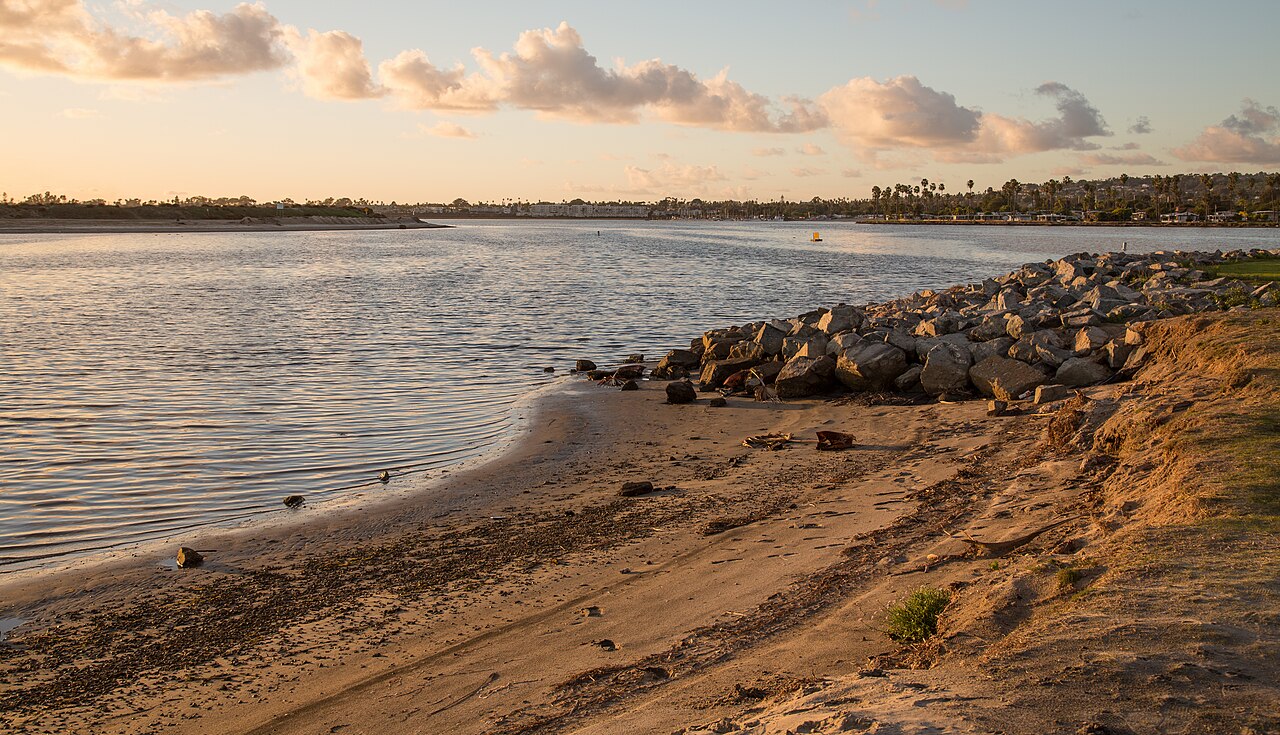
Continue south and San Diego’s coastline becomes Mission Bay.
The City describes Mission Bay Park as more than 4,235 acres, divided roughly equally between land and water, with 27 miles of shoreline. Nineteen miles are sandy beaches, and the park contains numerous islands, coves, paths and recreation areas.
That scale is important.
Mission Bay is not simply another beach.
It is an aquatic park system large enough to create its own geography between the Pacific Ocean and the rest of San Diego.
Mission Beach sits on the ocean side.
Pacific Beach lies immediately to the north.
Ocean Beach and Point Loma sit farther south and west.
Then, beyond Point Loma, the coast turns into San Diego Bay.
Point Loma Separates Two San Diego Waterfronts
Point Loma creates a useful geographic pivot in the page.
To the west is the Pacific Ocean.
To the east is San Diego Bay.
The City’s Peninsula planning area includes neighborhoods such as Point Loma Highlands, La Playa, Sunset Cliffs, Roseville, Loma Portal and Liberty Station. The Peninsula is bounded by the Pacific on one side and San Diego Bay on the other.
This is one of San Diego’s strongest geographic relationships:
ocean coast → peninsula → protected bay
The waterfront experience changes completely once the city turns into San Diego Bay.
The Embarcadero Brings the Bay Directly Into Downtown
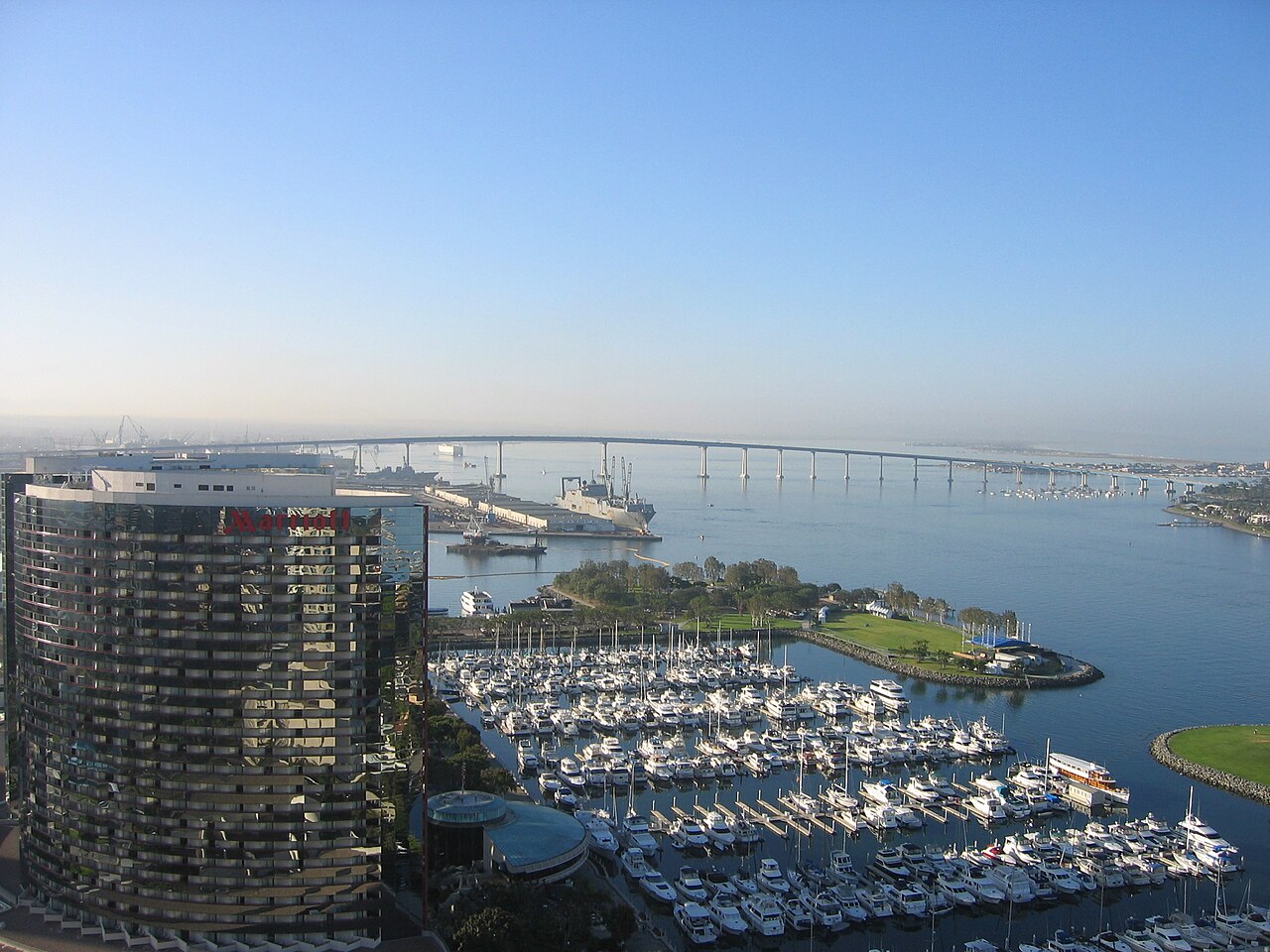
San Diego Bay becomes unmistakably urban at the Embarcadero.
The Port of San Diego describes the Embarcadero as a roughly two-mile Downtown waterfront containing cruise terminals, museums, visitor attractions, hotels, restaurants and public spaces.
San Diego Bayfront Park, beside the Convention Center, provides direct water views at the southern end of this Downtown waterfront.
This creates a very different city center from inland Downtowns.
Cruise ships, Navy and maritime activity, public promenades, the Convention Center and dense urban blocks all occupy the same general Bay edge.
Little Italy Grew From San Diego’s Tuna-Fishing Economy
At the northern side of Downtown, Little Italy gives the waterfront another historic layer.
The City says thousands of Italian families settled in the area in the early twentieth century and worked alongside Mexican, Japanese and Portuguese immigrants in San Diego’s tuna-fishing industry. Today, the neighborhood is centered around India Street and sits beside the North Embarcadero.
That makes Little Italy more useful than a restaurant recommendation.
Its location connects:
immigration → fishing economy → waterfront → modern Downtown residential district
Downtown San Diego Is Actually Eight Neighborhoods
The City identifies eight distinct neighborhoods within Downtown:
- Gaslamp;
- East Village;
- Columbia;
- Marina;
- Cortez;
- Little Italy;
- Horton Plaza;
- Core.
That distinction matters because Downtown should not be reduced to the Gaslamp Quarter.
The Gaslamp has its historic entertainment identity.
East Village surrounds major residential, cultural and ballpark development.
Little Italy occupies the northern waterfront edge.
Marina connects toward the Convention Center and Bay.
The Core contains much of the civic and commercial center.
This is a much more accurate way to explain Downtown San Diego than treating every central block as one district.
The Gaslamp Quarter Is Only One Version of Downtown
The Gaslamp Quarter is one of San Diego’s most recognizable central districts, but it belongs within a larger Downtown story.
Its historic commercial buildings, restaurants, nightlife and event activity sit only blocks from the Convention Center, East Village and waterfront.
The City maintains a specific Gaslamp Quarter planning ordinance and design framework, reinforcing that it has its own historic and urban-design identity within Downtown.
A strong San Diego page uses Gaslamp as one Downtown layer, not as shorthand for the whole city.
Balboa Park Sits Between Downtown and San Diego’s Uptown Neighborhoods
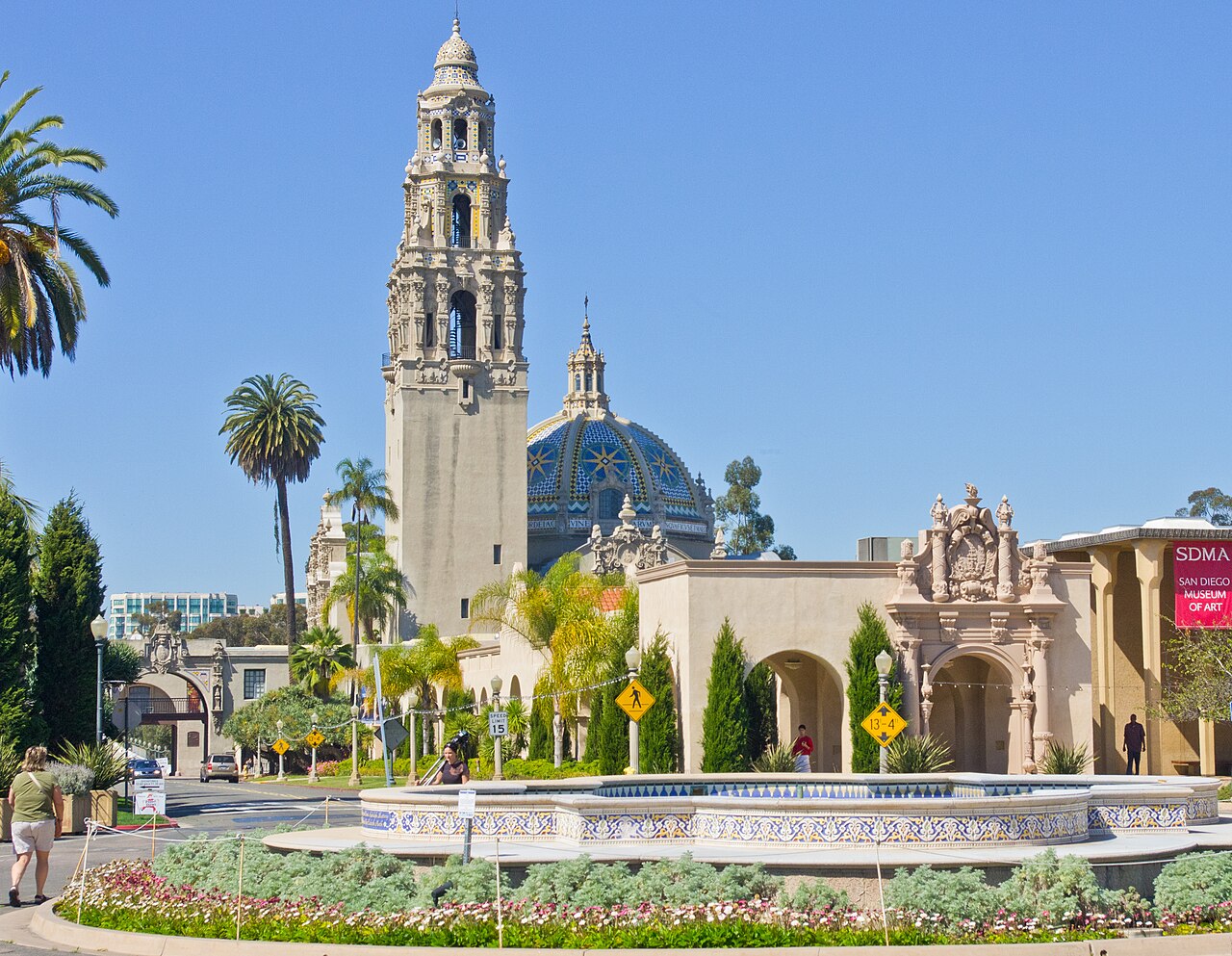
From Downtown, move north and the city changes sharply again.
Balboa Park covers more than 1,000 acres and contains 15 museums, gardens, arts organizations, cultural institutions and the San Diego Zoo. The City notes that many of the buildings along El Prado were constructed for the 1915–1916 Panama-California Exposition and are recognized for their Spanish Colonial Revival architecture.
Another City description places the park at roughly 1,200 acres when considering the broader park landscape and facilities.
Balboa Park’s significance comes from concentration.
Gardens.
Museums.
Performing arts.
Historic exposition architecture.
Public recreation.
Zoo.
All of it sits just minutes from Downtown.
That makes Balboa Park the ideal eastern/northern urban endpoint for this page’s central San Diego story.
Balboa Park Connects Downtown With Hillcrest, North Park and Uptown
The City’s Uptown planning area lies immediately north of Downtown and alongside Balboa Park.
It includes Hillcrest, Mission Hills, Bankers Hill/Park West, University Heights, Middletown and the Medical Complex.
North Park and South Park occupy distinct communities around the park’s eastern side.
This is another useful San Diego relationship:
Downtown → Balboa Park → Uptown/North Park residential and commercial districts
The park is not isolated from the city.
It acts as a major green and cultural divide between several of San Diego’s most recognizable central neighborhoods.
San Diego’s Trolley Connects Downtown to UC San Diego, East County and the Border
San Diego Metropolitan Transit System describes the Trolley as light rail connecting Downtown with East County, UC San Diego, South Bay and the Mexico border.
This scale matters.
The system does not simply circulate Downtown.
The UC San Diego Blue Line links central San Diego with the University area and continues south toward San Ysidro.
Other lines connect Downtown with Mission Valley and eastern communities.
For an evergreen city page, exact service times should remain on the live MTS resource.
The important point is geographic:
The coast, Downtown, university areas, inland districts and the border region are all part of one large municipal transportation story.
San Ysidro Gives San Diego an International-Border Endpoint
San Diego does not simply extend north along the coast.
Its municipal geography also reaches south to San Ysidro, immediately beside the U.S.–Mexico border.
The City lists San Ysidro as one of its official community planning areas.
The Trolley’s Blue Line links Downtown and central San Diego with the border area.
That relationship makes San Diego unusually expansive:
Torrey Pines in the northwestern coastal city → Downtown and Balboa Park in the center → San Ysidro at the international border
Very few U.S. city pages require that kind of municipal-geography range.
What’s Happening in San Diego? Events Follow the City’s Major Districts

San Diego has enough durable recurring events to make the events section part of the city story rather than filler.
Comic-Con Transforms Downtown
Comic-Con is one of San Diego’s defining annual events.
In 2026, Comic-Con ran July 22–26 at the San Diego Convention Center, and a newly announced agreement keeps the convention in San Diego through 2030. The event began in San Diego in 1970 and has grown into a globally recognized pop-culture convention.
Its impact extends beyond the Convention Center into Gaslamp, East Village, the waterfront, hotels and other Downtown spaces.
That relationship is why Comic-Con belongs here:
Convention Center event → entire Downtown district activation
December Nights Belongs to Balboa Park
December Nights provides the opposite event geography.
Rather than occupying Downtown streets, it takes over Balboa Park.
The 2026 event is scheduled for December 4–5 and includes performances, lights, food, vendors and seasonal programming.
For evergreen copy, exact dates should be updated annually.
The durable relationship is:
Balboa Park’s museums and gardens become a citywide holiday gathering place.
San Diego Pride Connects Hillcrest and Balboa Park
San Diego Pride is particularly useful because it connects two major local entities.
The annual July celebration includes a parade through Hillcrest and a two-day festival in Balboa Park.
That gives the event a real geographic role in this page:
Hillcrest → Balboa Park
Seasonal Events Use Different Parts of the City
San Diego’s official tourism organization also identifies recurring traditions including:
- Cinco de Mayo programming in Old Town;
- holiday Parade of Lights on San Diego Bay;
- multiple film festivals;
- seasonal Gaslamp events;
- other annual cultural festivals.
Use current organizer pages for exact dates, street closures and ticketing.
San Diego Neighborhoods and Nearby Cities Should Stay Separate
San Diego’s unusually irregular boundary makes geographic accuracy essential.
Within the City of San Diego are places such as:
- La Jolla;
- Pacific Beach;
- Mission Beach;
- Ocean Beach;
- Point Loma;
- Downtown;
- Hillcrest;
- North Park;
- South Park;
- University City;
- Mira Mesa;
- Rancho Bernardo;
- Carmel Valley;
- Otay Mesa;
- San Ysidro.
Nearby communities may feel continuous but are separate municipalities.
Del Mar is separate immediately north of Torrey Pines.
Coronado is a separate city across San Diego Bay.
National City is separate south of central San Diego.
Chula Vista is separate farther south.
La Mesa, Lemon Grove, El Cajon and Santee are separate East County cities.
Poway is a separate city inland to the north.
That distinction is especially important for future local-page architecture.
Receiving Mushroom Shipping at San Diego Homes, Condos and Apartments
San Diego’s housing environment varies enormously by district.
Downtown and Little Italy contain high-rise and managed apartment buildings.
Hillcrest, North Park and University Heights mix older multifamily properties with newer buildings.
La Jolla includes houses, condominiums and student-oriented housing.
Mission Valley has large multifamily developments.
Carmel Valley and Rancho Bernardo include master-planned residential communities.
South San Diego contains another mix of detached homes and apartments.
A parcel may therefore be handled through a porch, mailroom, locker, concierge, leasing office, front desk or other property-specific system.
Psychedelics Zone does not control those receiving procedures.
[INTERNAL LINK: “Review Current Shipping Information” → /shipping-policy/]
Compare Mushroom Gummies, Chocolates, Capsules and Other Formats
People searching for magic mushrooms San Diego, mushroom chocolates San Diego, mushroom chocolate bars San Diego or shroom bars San Diego may use those phrases broadly.
The live product listing matters more than the keyword.
The current Psychedelics Zone Shop lists gummies, chocolates, capsules, tinctures, spritzes, drink mixes, dried mushroom products, wellness products and bundles.
Compare Current Mushroom Products →
Mushroom Gummies
Mushroom gummies offer a flavored edible format.
Formulations vary by product, so shoppers should review the current individual listing rather than assuming every mushroom gummy contains the same ingredients.
Mushroom Chocolates and Chocolate Bars
Chocolate deserves meaningful semantic coverage because the uploaded keyword dataset shows major search demand around mushroom chocolate, shroom bars and mushroom chocolate bars.
The live Shop currently includes a dedicated Chocolate category and multiple chocolate-bar listings. Exact ingredients and formulations belong to individual product pages.
Mushroom Capsules
Capsules provide another format for shoppers who prefer something other than gummies or chocolates.
Drink Mixes
Drink mixes provide a beverage-format option among the current catalog categories.
Other Current Formats
The live shop also lists tinctures, spritzes, fruit/dried formats, Wellness & Intention products and bundles.
A mushroom product should not automatically be treated as a psilocybin product simply because someone reached this page through a search for psilocybin San Diego or magic mushrooms San Diego.
The live individual product listing is the source of truth.
What Should You Look for Before Choosing?
The Psychedelics Zone article How to Select Quality Mushrooms for Safe Use discusses product labels, packaging and quality-evaluation considerations.
How to Select Quality Mushrooms for Safe Use →
Use educational content as general background, then use the current individual product page for exact ingredients, formulation, serving details and availability.
Explore Current Psychedelics Zone Brands
Brand availability changes.
Use the current Brands directory rather than maintaining a static brand roster on this city page.
Explore Psychedelics Zone Brands →
The live site currently maintains a dedicated brands directory.
Frequently Asked Questions
Does Psychedelics Zone offer mushroom delivery in San Diego?
Psychedelics Zone serves San Diego through online shipping rather than a locally dispatched San Diego courier. Mushroom delivery San Diego is targeted because it reflects search intent, but this page does not claim same-day or local-courier delivery.
Does Psychedelics Zone ship mushroom products to San Diego?
The current Shipping Policy states that Psychedelics Zone ships eligible orders to all 50 U.S. states, which includes California. Use a valid street address and review the live policy before ordering.
Is mushroom shipping to San Diego discreet?
The current policy says orders ship in plain, discreet packaging without product details visible on the exterior. This does not guarantee private receipt if an apartment, university, condominium or managed building uses shared package handling.
Is La Jolla actually part of San Diego?
Yes. La Jolla is a community within the City of San Diego, about 12 miles north of Downtown. The City identifies the Village, Shores and Bird Rock as distinct commercial areas within the community.
Is Torrey Pines inside San Diego?
Yes. The Torrey Pines community is in the northwestern City of San Diego, bordering the Pacific Ocean and the separate City of Del Mar. Torrey Pines State Beach is also within San Diego city limits.
How large is Mission Bay Park?
The City describes Mission Bay Park as more than 4,235 acres with 27 miles of shoreline, making it the largest aquatic park of its type in the country.
Is Balboa Park close to Downtown?
Yes. Balboa Park sits only minutes from Downtown and contains more than 1,000 acres of museums, gardens, cultural institutions and recreation areas.
Does the San Diego Trolley reach UC San Diego and the border?
Yes. MTS states that the Trolley connects Downtown with UC San Diego, East County, South Bay and the Mexico border.
From Coastal Bluffs to Balboa Park
San Diego becomes much more interesting when you follow the coastline inward.
Start at Torrey Pines.
Sandstone bluffs rise above the Pacific.
Travel south and La Jolla combines beaches, cliffs, research institutions and university life.
Continue toward Mission Bay and the coastline becomes a vast aquatic park.
Point Loma separates the open Pacific from protected San Diego Bay.
Inside the Bay, the city turns urban.
The Embarcadero meets Downtown.
Little Italy recalls a fishing economy built by immigrant communities.
Gaslamp and East Village add different versions of the central city.
Then Balboa Park opens into gardens, museums and exposition architecture only minutes away.
Bluffs. Coast. Bay. Harbor. Downtown. Park.
That is San Diego.
When you’re ready to compare products, Psychedelics Zone lets San Diego customers browse mushroom gummies, mushroom chocolates and chocolate bars, capsules, drink mixes and other current formats online before reviewing shipping information and placing an eligible order.
[GOOGLE BUSINESS PROFILE LINK — PENDING VERIFIED URL]
Responsible Purchasing
The current Psychedelics Zone Shipping Policy states that customers confirm they are 21+ when ordering and are responsible for complying with applicable local and state laws.
Review current individual product pages for exact ingredients, formulation, serving information and availability.
Do not assume a mushroom product contains psilocybin unless the current product listing specifically verifies that formulation.
Never drive, surf, swim, boat, cycle, paraglide or participate in any activity requiring alertness, balance, coordination or judgment while impaired.
Product and educational information should not be interpreted as medical advice.
ZIP Codes Serving San Diego
San Diego postal geography is unusually complex because the city has irregular municipal boundaries and several ZIP codes cross into neighboring areas or serve institutional/special-purpose addresses.
City Council district materials identify the following ZIP areas as lying wholly or partly inside the City of San Diego:
92014, 92037, 92038, 92067, 92093, 92101, 92102, 92103, 92104, 92105, 92106, 92107, 92108, 92109, 92110, 92111, 92113, 92114, 92115, 92116, 92117, 92119, 92120, 92121, 92122, 92123, 92124, 92126, 92127, 92128, 92129, 92130, 92131, 92132, 92134, 92139, 92145, 92154, 92171, 92173.
Important postal-boundary note: Some of these ZIP codes are only partially within the City, and some are institutional, military or otherwise nonstandard. For example, City District 1 explicitly says its listed ZIPs are wholly or partly within San Diego, and UC San Diego uses 92093 as an institutional address.
Use the complete valid street address rather than a ZIP code alone to determine the shipping destination.